


| Issue |
BSGF - Earth Sci. Bull.
Volume 197, 2026
|
|
|---|---|---|
| Article Number | 13 | |
| Number of page(s) | 8 | |
| DOI | https://doi.org/10.1051/bsgf/2026006 | |
| Published online | 29 May 2026 | |
VirtualPal: a remote undergraduate invertebrate paleontology practical course using 3D fossils
VirtualPal : un cours en ligne de travaux pratiques en paléontologie des invertébrés basé sur des fossils en 3D
1
Aix Marseille Univ, CNRS, IRD, INRAE, CEREGE, Aix-en-Provence, France
2
Aix Marseille Univ, CNRS, IRD, INRAE, OSU Inst. PYTHEAS, Marseille, France
3
Aix Marseille Univ, ADEF, Marseille, France
* e-mail: : This email address is being protected from spambots. You need JavaScript enabled to view it.
Received:
21
September
2025
Accepted:
30
March
2026
Abstract
Paleontology is a natural science discipline based on the observation of fossils. Therefore, paleontology education requires extensive training, and thus significant time, dedicated to observing and describing fossils. In the classroom, teachers often lack sufficient time to showcase the vast majority of key and basic fossil diversity typically encountered in the field. Moreover, students cannot spend enough time in class to properly study each sample. This challenge becomes even more critical in remote learning settings where access to fossils is limited. To address these limitations, we present a remote class dedicated to invertebrate paleontology bachelor’s students, based on a collection of 3D fossils. These models are reconstructed using photogrammetry and hosted online on the Sketchfab web platform. We present a comprehensive Moodle remote course, so-called VirtualPal, that seamlessly integrates instructional videos, interactive 3D fossil models, specific lessons, and formative and summative quizzes. The VirtualPal model can be easily adapted to other observational disciplines such as micropaleontology or petrology but still requires a proper evaluation of its effectiveness using educational science methodologies.
Résumé
La paléontologie est une discipline des sciences naturelles fondée sur l’observation des fossiles. Son enseignement exige donc une formation approfondie, et par conséquent un temps significatif, consacré à l’observation et à la description des fossiles. En salle de classe, les enseignants manquent souvent de temps pour présenter la majorité des fossiles clés et fondamentaux, généralement rencontrés sur le terrain. De plus, les étudiants ne peuvent pas consacrer suffisamment de temps en cours pour étudier chaque échantillon de manière adéquate. Ce défi devient encore plus crucial dans le cadre de l’enseignement à distance, où l’accès aux fossiles est limité. Pour répondre à ces contraintes, nous avons créé un cours à distance de paléontologie des invertébrés dédié aux étudiants en licence, basé sur une collection de fossiles en 3D. Ces modèles sont reconstruits par photogrammétrie et hébergés en ligne sur la plateforme Sketchfab. Dans le detail, le cours complet designé sur Moodle, nommé VirtualPal, intègre de manière fluide des vidéos pédagogiques, des modèles interactifs de fossiles en 3D, des leçons spécifiques, ainsi que des quiz formatifs et sommatifs. Le modèle VirtualPal peut être facilement adapté à d’autres disciplines observationnelles, telles que la micropaléontologie ou la pétrologie, mais nécessite encore une évaluation rigoureuse de son efficacité à l’aide de méthodologies issues des sciences de l’éducation.
Key words: Invertebrate paleontology / photogrammetry / 3D fossils / remote teaching / pedagogical design / moodle
Mots clés : Paléontologie des invertébrés / photogrammétrie / fossiles en 3D / enseignement à distance / modèle pédagogique / moodle
© B. Suchéras-Marx et al., Published by EDP Sciences 2026
 This is an Open Access article distributed under the terms of the Creative Commons Attribution License (https://creativecommons.org/licenses/by/4.0), which permits unrestricted use, distribution, and reproduction in any medium, provided the original work is properly cited.
1 Introduction
Paleontology is an observation-based science, similar to many other fields within geoscience. Education in paleontology, specifically invertebrate paleontology, is centered on the observation of fossils. Students are required to observe and identify the various morphological features of fossils and determine their taxonomic affiliation. As a result, undergraduate invertebrate paleontology courses dedicate a significant portion of class time to practical work.
However, most students do not have enough time to thoroughly study each fossil presented during class, as the number of specimens is often too large. In other words, the time allocated to practical work is too limited for students to practice on a sample set representative of the vast diversity of fossils found in nature. In many cases, a student may observe a given fossil only once, weeks before the exam. Conversely, the teaching of paleontology could be hampered in some emerging countries due to a lack of materials (i.e., fossils) or insufficient university buildings to accommodate the explosion in student numbers.
To encourage careful observation during practical sessions, students are typically asked to draw and annotate the fossils. The advent of low-cost digital cameras and smartphones has helped extend observation time and improve recognition by allowing students to take reference photos alongside their drawings. However, many of these photos are of insufficient quality to serve as reliable aids for further observation or sketching. Additionally, many students struggle to mentally reconstruct a 3D object from a series of 2D photographs. The benefits of 3D visualization in learning processes have been demonstrated across various scientific disciplines (e.g., Güven and Kosa, 2008; Silén et al., 2008; Abdinejab et al., 2021; Yamakami et al., 2022). Similarly, the ability to translate 2D information into a 3D understanding is a crucial skill in geosciences, one that requires more than a single undergraduate course to fully develop. What are so-called spatial thinking skills remain fundamentally important in the geosciences (Kastens and Ishikawa, 2006). Among the multiple dimensions of spatial thinking skills, this pedagogical project is mainly oriented toward developing (i) mental rotation, which is the ability to rapidly and accurately rotate a two- or three-dimensional figure in one’s mind (Kadam et al., 2021), and (ii) perspective taking, which is the cognitive ability to imagine how an object or scene would appear from a viewpoint different from one’s own current physical position and to a lesser extent. To a lesser extent, the spatial thinking of disembedding (the ability to separate a figure from its background, that is, to identify a shape hidden within a larger, visually complex configuration; Bodner and Guay, 1997) and penetrative thinking (which is the capacity for imaging the interior of an object; He et al., 2022) are addressed, although not specifically trained. These issues are also prevalent in fully remote paleontology courses. The materials typically provided consist of generalized morphological diagrams and series of fossil photographs. Students must then mentally translate these generic diagrams to specific specimens and infer their 3D structure from 2D images. Moreover, the learning process is often unsupervised, reducing its overall effectiveness (Clark and James, 2005; Day, 2022).
In this article, we describe a fully remote invertebrate paleontology course based on 3D invertebrate fossils (hereafter called VirtualPal), supplemented by instructional videos, Moodle-based lessons, and both formative and summative quizzes. Most of the fossils are reconstructed in 3D using photogrammetry, providing a realistic representation of their color, texture, and morphology. VirtualPal is hosted by Unisciel (Université des Sciences en ligne – Online Science University) and is freely accessible with open registration.
2 The VirtualPal learning objects
This study adopts the widely accepted definition of a learning object (LO) as “any digital resource that can be reused to support learning” (Wiley, 2002). Within the project, four categories of LOs are employed: interactive 3D fossil models, instructional videos, interactive lessons, and quizzes. The LOs are utilized and reused across multiple tiers of the VirtualPal pedagogical framework (see Section 3 below). All these LOs are structured in a moodle (see Section 3). Moodle is a free and open-source learning management system written in PHP, widely used worldwide by universities to host the digital parts (documents, images, etc.) of a course, for blended learning or even for distance learning.
2.1 3D fossils
The vast majority of the 3D models in the fossil collection are generated using photogrammetry. Most of the models are produced by the team SIGeo from CEREGE using the protocol described below. A few other contributions come from colleagues from Université Paul Sabatier, Toulouse, namely Marc de Rafélis and Océane Nicolas, using a similar procedure. The complete methodology, including parameters, setup procedure, and relevant literature, is provided in the supplementary material (Supplementary Material 1).
The basic principle of the structure-from-motion (SfM) photogrammetry method hereby applied (e.g., Granshaw, 2016) involves taking images from multiple angles, ranging from planar to apical views, by rotating the specimen on a turntable. The specimen is then repositioned to repeat the process for all its faces. Photographs are taken using four CanonTM EOS 77D cameras, each equipped with a 24.2-megapixel CMOS sensor (22.3 × 14.9 mm) and a resolution of 6000 × 4000 pixels. Macro lenses are selected as a function of the subject’s dimensions, either a 60 mm f/2.8 for large objects (up to 40 cm) or a 100 mm f/2.8 for small objects (down to 2 cm). The number of photos taken per sample ranges from 192 to 576, depending on the specimen’s surface complexity. To ensure high-quality images, lighting conditions are controlled using a Foldio© Studio 360 lightbox and four LED panels (Dörr© 3040BC).
The typical image processing workflow includes the following: (i) loading and cleaning the images; (ii) aligning and orienting the images through tie-point detection and bundle block adjustment; (iii) generating a dense point cloud via dense image correlation; and (iv) meshing the dense cloud and texturing the model using the original images.
This process is carried out using Agisoft© Metashape Professional version 1.8. Once a 3D reconstruction meets sufficient quality standards, it is exported in.obj format and uploaded online. Although Sketchfab generously provides free Pro accounts to academic institutions through its support program, the maximum file size per model is limited to 200 MB. Therefore, the resolution of some models has to be reduced, though this never compromises key morphological features.
The fossils reconstructed using photogrammetry are hosted online on Sketchfab. Sketchfab is the largest online platform for hosting, viewing, manipulating, and sharing 3D models. This platform was selected because of its HTML integration capabilities. The collection is titled Secteur Sciences et Technologies – AMU1 and corresponds to a Pro account provided by Sketchfab through its education support program. All teaching samples, except those used for evaluation, are openly accessible and downloadable directly from Sketchfab under the CC-BY-NC-SA 4.0 license. Out of the 104 samples used for teaching, 72 are annotated using Sketchfab’s built-in annotation tool (Fig. 1), while the 78 specimens used for formative and summative evaluation purposes are not annotated. The annotations are based on the Paleontology class taught at Aix-Marseille University by Bertrand Martin-Garin and Baptiste Suchéras-Marx and controlled using a textbook, Paléontologie et évolution des invertébrés (Dera et al., 2025).
The manipulation of 3D fossils actively engages students in exercising multiple critical spatial thinking skills. First, mental rotation skill is trained by moving the fossils in any direction, which facilitates comprehending the various shapes of the fossils. Second, disembedding skill is exercised by focusing on specific features across the entire fossil, extracting the critical piece of information. Third, perspective-taking skill is trained by moving the fossils to the different key views where morphological features are visible. Fourth, in rare cases, the penetrative thinking skill is exercised by observing internal features from external views, forcing one to imagine the internal organization.
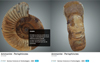 |
Fig. 1 On the left panel, an ammonite in side view with the annotation n°1 open. On the right, the same ammonite in frontal view moved 90° to the left. |
2.2 Videos
A series of videos (Table 1) were previously recorded to demonstrate how to use Sketchfab (1 video) and to present the morphological features of each fossil group or subgroup (12 videos). The videos are captured using OBS Studio, showing both (i) the instructor via the webcam of a Dell Precision 3571 laptop (32 GB RAM, 64-bit, 12th Gen Intel® Core™ i7-12700H 2.30 GHz) running Windows 10 Professional and (ii) the 3D fossil model on Sketchfab, accessed through the Firefox browser. Audio is simultaneously recorded using an external Røde NT-USB microphone. No video editing is used. Videos are hosted on AMUpod2 and accessible without registration, although those were designed to be used in the remote class and not without it.
Except for the first video, there is a basic organization used for all of them with the presentation of typical morphological features on several specimens and a quick but not exhaustive tour of the diversity of shapes of the shells within a given group. The videos help students to bridge the gap between simple passive observation and active use of the 3D fossils. The manipulation within the videos, although primarily used to guide observation and identification of morphological features, also shows the process that would ultimately result in training in mental rotation, disembedding, and perspective-taking processes.
2.3 Lessons
A lesson is a specific activity in Moodle, basically a series of pages with branching and learning paths based on student choice or correctness in formative evaluation. Several lessons have been designed in VirtualPal to address specific topics often challenging for students. Within each page of a lesson, a text is supplemented with a 3D fossil. The text guides the student toward the specific features that should be observed. Step by step, morphological features are shown. At the end of the lesson, a formative evaluation is given. In case of success, the lesson is completed and rewarded with a badge. In case of failure, the student is sent back to the page showing the morphological features that were not identified. Lessons may focus on specific spatial skills, namely disembedding and penetrative thinking. But in many cases, these are also designed to teach the correct taxonomic or morphological nomenclature used for descriptions.
List of the embedded videos with durations and the pedagogical purposes.
2.4 Quizzes
A quiz is a specific activity in Moodle. It is one or several questions that could be specifically organized or sampled randomly in a question bank. The design of every question in VirtualPal follows these principles: (i) a multiple-choice question with only one correct answer out of four possibilities (sometimes three or five); (ii) a question is always composed of a question and a 3D fossil (e.g., which morphological feature is labeled by annotation 1?); (iii) a specific feedback is associated with every answer, correct or incorrect; and (iv) the order of the possible answers is randomized. The quiz itself has a minimum of 10 questions and up to 21 questions depending on the quiz type. In VirtualPal, two types of quizzes are designed, formative evaluation for training and summative evaluation for validation of the course. Quizzes are not designed to train specific spatial skills, but students will need to sufficiently master these skills to succeed.
3 Pedagogical organization of VirtualPal
The VirtualPal platform integrates the three aforementioned LO types within a systematically structured Moodle learning environment. It is hosted on Socles3, the Unisciel platform running Moodle version 4.0. Unisciel is the French online university for science, offering free and open-access courses and educational resources3
First, the main objective of using 3D fossils is to provide students with unrestricted access to fossil specimens, accompanied by detailed annotations directly on the fossil itself and, importantly, a realistic 3D representation with natural color and texture. Second, 3D fossils can easily be integrated into videos, lessons, and quizzes, thereby expanding the range of pedagogical activities and enhancing learning effectiveness. VirtualPal is designed to help students learn to recognize common invertebrate fossils without any lectures or fieldwork. It is structured as a fully self-contained remote learning experience. VirtualPal is divided into sections, each of which contains several chapters. The structure is composed of an Introduction section, Collection section, Taxonomical chapter sections, and Summative section (Fig. 2).
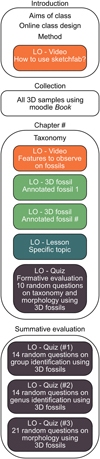 |
Fig. 2 VirtualPal organization. There are seven thematic chapters organized based on taxonomy. The different colors represent the four types of LOs: embedded videos, embedded Sketchfab 3D fossils, lessons, and quizzes. |
3.1 Introduction section
The first section is called Introduction. It explains the objectives of the course, its organization, and the recommended working methodology through a short text. This section also includes a video that demonstrates how to use Sketchfab. In the video, the narrator shows how to manipulate a fossil in 3D using Sketchfab and how to navigate from one annotation to another. This section is essential for students to understand the course’s purpose and how to engage with the content effectively.
3.2 Collection section
The second section is called Collection. It contains a Moodle book resource with all the 3D fossils. This resource is organized according to taxonomy, with chapters (e.g., Mollusca, Echinodermata) and, when necessary, subchapters (e.g., Mollusca–Bivalvia, Cephalopoda, etc.). The objective of this section is to centralize access to the complete set of 3D fossils; learners are able to explore and consult any of the models independently and at their convenience.
3.3 Taxonomical chapter sections
The following sections are taxonomical chapters, with seven chapters:
Mollusca–Gastropoda (1 video, 9 3D fossils, 1 lesson)
Mollusca–Bivalvia (2 videos, 12 3D fossils, 2 lessons)
Mollusca–Cephalopoda (5 videos, 22 3D fossils, 2 lessons)
Brachiopoda (1 video, 7 3D fossils, 1 lesson)
Echinodermata (2 videos, 9 3D fossils)
Cnidaria (1 video, 10 3D fossils, 2 lessons)
Trilobita (1 video, 3 3D fossils)
Within each chapter, there is a list of taxa hosted in this section, including their full taxonomy down to the genus level. Students are expected to recognize and name these specimens down to the genus level. One or more videos highlight (using 3D fossil manipulation) the main morphological characteristics that must be observed and identified. The narrator uses Sketchfab directly to simulate student interactions and to explain the key observations. The fossils shown in the videos are typical examples; not all 3D fossils are displayed.
Then, a subsection called Observe hosts the annotated 3D fossils. The last subsection labeled Learn, which is not always present, contains one or two Moodle lesson activities. Each lesson has a specific purpose and includes an evaluation at the end. The lessons are:
recognize growth lines from ornamentation in gastropods (disembedding skill);
recognize the different hinges in bivalves;
recognize suture lines in cephalopods (disembedding and penetrative thinking skills);
distinguish the difference between nautiluses, goniatites, ceratites, and ammonites;
distinguish the difference between brachiopods and bivalves;
recognize the different morphologies of colonies in scleractinian corals;
recognize the organization of corallites in scleractinian corals.
At the end of each chapter, there is a quiz activity used as formative evaluation focusing exclusively on the specimens from that chapter. This quiz consists of ten questions covering three themes:
two questions on group identification;
two questions on genus identification within a group;
six questions on morphological characteristic identification within a group.
In each quiz, questions are randomly sampled from different question banks (Table 2). Students have unlimited attempts for these quizzes and can use them to practice recognizing fossils or identifying morphological characteristics. As a formative evaluation, feedback is provided to the students. In this way, students identify which concepts they actually master and where they need additional practice, fostering self-regulated learning.
Number of questions per taxonomic group and per task (i.e., group identification, genus identification, and morphological characteristics identification).
3.5 Summative evaluation section
The final section, called Evaluation, consists of three quiz activities using the same question database as the quizzes at the end of the chapters.
The first quiz assesses the student’s ability to identify a fossil at the group level. It is accessible only if the student has attempted each chapter quiz at least once. This quiz contains 14 questions–2 per group–randomly sampled from a set of 67 questions. To pass, the student must correctly answer at least 9 questions within 21 min. There is no limit to the number of attempts. The second quiz evaluates the student’s ability to identify a fossil at the genus level. It is available only if the student has passed the first evaluation quiz. This quiz also contains 14 questions–2 per group–randomly sampled from a set of 61 questions. To pass, the student must correctly answer at least 9 questions within 21 min. There is no limit to the number of attempts. The third and final evaluation quiz tests the student’s ability to recognize morphological characteristics for each group. It includes 21 questions–3 per group–randomly sampled from a set of 174 questions. To pass, the student must correctly answer at least 14 questions within 32 min. There is no limit to the number of attempts. Passing the last quiz is considered validation of the remote course.
3.6 Evolution of the pedagogical model and caveats
VirtualPal was originally based on a blended class that used 3D fossils for students’ revision prior to the final practical exam. In this blended class, the first versions of the project consisted only of a collection of 3D fossils. This model was updated following students’ recommendations requesting more organization, guidance, and help in recognizing fossils’ morphological characteristics. Hence, the series of videos and lessons was added. Although lesson activities are used less frequently than videos, they were also incorporated. Moreover, skill validation was not introduced until the design of the final evaluation quizzes. Thus, the class presented here now guides students through the learning process between and within taxonomic chapters. This new pedagogical model from the blended class version at Aix-Marseille Université was then adapted to construct the remote class on Socles3.
Despite significant improvements over the years, some limitations remain. The main limitation of the remote class is its total disconnection from any lecture-based paleontology or evolution courses and from fieldwork. The objectives are not anchored in a broader context, which may reduce students’ interest in the class. Additionally, students cannot physically handle the samples, losing access to tactile information that could aid identification, such as weight or texture. Finally, because this class is fully remote, there is no evaluation of students’ abilities to draw fossils or identify fossils in rock matrices, where characteristics may be less visible.
4 Conclusions
Remote classes in natural science disciplines are challenging because they require designing the course around the main targeted competencies, namely observation and description. The 3D fossils and associated resources presented here succeed in that aspect. The design of this type of class is also easily transferable to other disciplines in earth science, such as micropaleontology, vertebrate paleontology, or petrology.
Currently, according to the literature, the earth science community is more focused on the development of virtual fieldwork (e.g., Mead et al., 2019; Métois et al., 2021; Guillaume et al., 2023), although several developments in virtual microscopes have also been seen (e.g., Engel et al., 2023), and several projects using 3D objects in earth science teaching are developed in numerous universities worldwide (e.g., Université Franche-Comté, Université de Liège, and University of Newcastle). Open-access remote classes represent an interesting opportunity for students in emerging countries where pedagogical materials are often lacking. They also offer an opportunity for teachers, who can use the activities or 3D materials to design blended classes at their own universities. However, the remaining caveat of the pedagogical model presented here is the lack of evaluation of learning efficiency following educational science protocols.
Acknowledgments
Sophie Jequier is warmly thanked for her comments on the pedagogical model developed on Socles3. The original project called VirtualPal was funded by the FIP (i.e., Pedagogical Intervention Fund) program by Aix-Marseille université in 2018. This manuscript is a contribution to the team Climate at CEREGE, OSU Pythéas, Aix-Marseille Université. We also thank the reviewers–Valentin Fischer and Nicolas Rudolph Thibault–as well as the associate editor Borja Cascales-Minana and the editor-in-chief Olivier Vanderhaeghe for their constructive comments on the submitted version.
Author contribution statement
Baptiste Suchéras-Marx: conceptualization, funding acquisition, project administration, resource, visualization, writing–original draft preparation, writing–review & editing. Yann Ternois: investigation, validation, writing–original draft preparation, writing–review & editing. Jules Fleury: data curation, investigation, methodology, supervision, validation, writing–review & editing. Paul Ré: investigation. Bertrand Martin-Garin: investigation. Jérémy Castéra: validation, writing–original draft preparation.
Supplementary Material
Exhaustive description of the photogrammetry set-up and methodology applied with a picture of our structure for photo capture and a table describing the camera and set-up parameters used.
Fig. S1. (a) Photographic setup. C1 to C4: synchronized cameras at equal distance to the sample S. T: turntable with default 15° rotation step and infrared triggering device. H: Ball head. Horizontal arms on the stand and camera ball heads can be displaced vertically and horizontally. (b) Plan view of the lighting configuration. St: Studio box; HB: Halo bar; LP: Led panel.
Fig. S2 Background image with textured pattern and coded markers, modified from Porter et al. (2016). It is set down on the turntable with the sample.
Table S1. Hardware configuration and size of typical 3D projects.
Table S2. Agisoft Metashape's processing parameters specific to our study.
Access Supplementary MaterialReferences
- Abdinejad M, Talaie B, Qorbani HS, Dalili S. 2021. Student perceptions using augmented reality and 3D visualization technologies in chemistry education. Journal of Science Education and Technology 30: 87–96. https://doi.org/10.1007/s10956-020-09880-2 [Google Scholar]
- Bodner GM, Guay RB. 1997. The Purdue visualization of rotations test. The Chemical Educator 2(4): 1–17. https://doi.org/10.1007/s00897970138a [Google Scholar]
- Clark I, James P. 2005. Blending what? An approach to delivering earth science courses online. International Journal of Innovation in Science and Mathematics Education 14(1): 1–11. [Google Scholar]
- Day JJ. 2022. Transformation of geological sciences and geological engineering field methods course to remote delivery using manual, virtual, and blended tools in fall 2020. Geoscience Communication 5: 381–395. https://doi.org/10.5194/gc-5-381-2022 [Google Scholar]
- Dera G, Nardin É, Aretz M, Perrier V. 2025. Paléontologie et évolution des invertébrés. Dunod, Malakoff, 279 pp. [Google Scholar]
- Engel KT, Davidson J, Jolley A, Kennedy B, Nichols ARL. 2023. Development of a virtual microscope with integrated feedback for blended geology labs. Journal of Geoscience Education 72(1):1–15. https://doi.org/10.1080/10899995.2023.2202285 [Google Scholar]
- Granshaw SI. 2016. Photogrammetric terminology: third edition. The Photogrammetric Record 31(154): 210–252. https://doi.org/10.1111/phor.12146 [Google Scholar]
- Guillaume L, Laurent V, Genge MJ. 2023. Immersive and interactive three-dimensional virtual fieldwork: Assessing the student learning experience and value to improve inclusivity of geosciences degrees. Journal of Geoscience Education 71:462–475. https://doi.org/10.1080/10899995.2023.2200361 [Google Scholar]
- Güven B, Kosa T. 2008. The effect of dynamic geometry software on student mathematics teachers' spatial visualization skills. The Turkish Online Journal of Educational Technology 7: 100–107. [Google Scholar]
- He C, Chrastil ER, Hegarty M. 2022. A new psychometric task measuring spatial perspective taking in ambulatory virtual reality. Frontiers in Virtual Reality 3: 971502. https://doi.org/10.3389/frvir.2022.971502 [Google Scholar]
- Kadam K, Mishra S, Deep A, Iyer S. 2021. Enhancing engineering drawing skills via fostering mental rotation processes. European Journal of Engineering Education 46(5): 796–812. https://doi.org/10.1080/03043797.2021.1920891 [Google Scholar]
- Kastens KA, Ishikawa T. 2006. Spatial thinking in the geosciences and cognitive sciences: A cross-disciplinary look at the intersection of the two fields. In: Manduca CA, Mogk DW, eds. Earth and Mind: How Geologists Think and Learn about the Earth. Geological Society of America 413, pp. 53–76. https://doi.org/10.1130/2006.2413(05). [Google Scholar]
- Mead C, Buxner S, Bruce G, Taylor W, Semken S, Anbar AD. 2019. Immersive, interactive virtual field trips promote science learning. Journal of Geoscience Education 67: 131–142. https://doi.org/10.1080/10899995.2019.1565285 [Google Scholar]
- Métois M, Martelat JE, Billant J, Andreani M, Escartín J, Leclerc F, the ICAP team. 2021. Deep oceanic submarine fieldwork with undergraduate students: an immersive experience with the Minerve software. Solid Earth 12: 2789–2802. https://doi.org/10.5194/se-12-2789-2021 [Google Scholar]
- Silén C, Wirell S, Kvist J, Nylander E, Smedby Ö. 2008. Advanced 3D visualization in student-centred medical education. Medical Teacher 30: e115–e124. https://doi.org/10.1080/01421590801932228 [Google Scholar]
- Wiley DA. 2002. Connecting learning objects to instructional design theory: a definition, a metaphor, and a taxonomy. In: The instructional use of learning objects. Bloomington, IN: Agency for Instructional Technology, 35 p. http://reusability.org/read/chapters/wiley.doc [Google Scholar]
- Yamakami SA, Nagai M, Chutinan S, Ohyama H. 2022. 3D Digital technology as an alternative educational tool in preclinical dentistry. European Journal of Dental Education 26: 733–740. https://doi.org/10.1111/eje.12755 [Google Scholar]
Cite this article as: Suchéras-Marx B, Ternois Y, Fleury J, Ré P, Martin-Garin B, Castéra J. 2026. VirtualPal: a remote undergraduate invertebrate paleontology practical course using 3D fossils, BSGF - Earth Sciences Bulletin 197: 13. https://doi.org/10.1051/bsgf/2025021
All Tables
Number of questions per taxonomic group and per task (i.e., group identification, genus identification, and morphological characteristics identification).
All Figures
|
Fig. 1 On the left panel, an ammonite in side view with the annotation n°1 open. On the right, the same ammonite in frontal view moved 90° to the left. |
| In the text | |
|
Fig. 2 VirtualPal organization. There are seven thematic chapters organized based on taxonomy. The different colors represent the four types of LOs: embedded videos, embedded Sketchfab 3D fossils, lessons, and quizzes. |
| In the text | |
Current usage metrics show cumulative count of Article Views (full-text article views including HTML views, PDF and ePub downloads, according to the available data) and Abstracts Views on Vision4Press platform.
Data correspond to usage on the plateform after 2015. The current usage metrics is available 48-96 hours after online publication and is updated daily on week days.
Initial download of the metrics may take a while.