


Fig. 4
Download original image
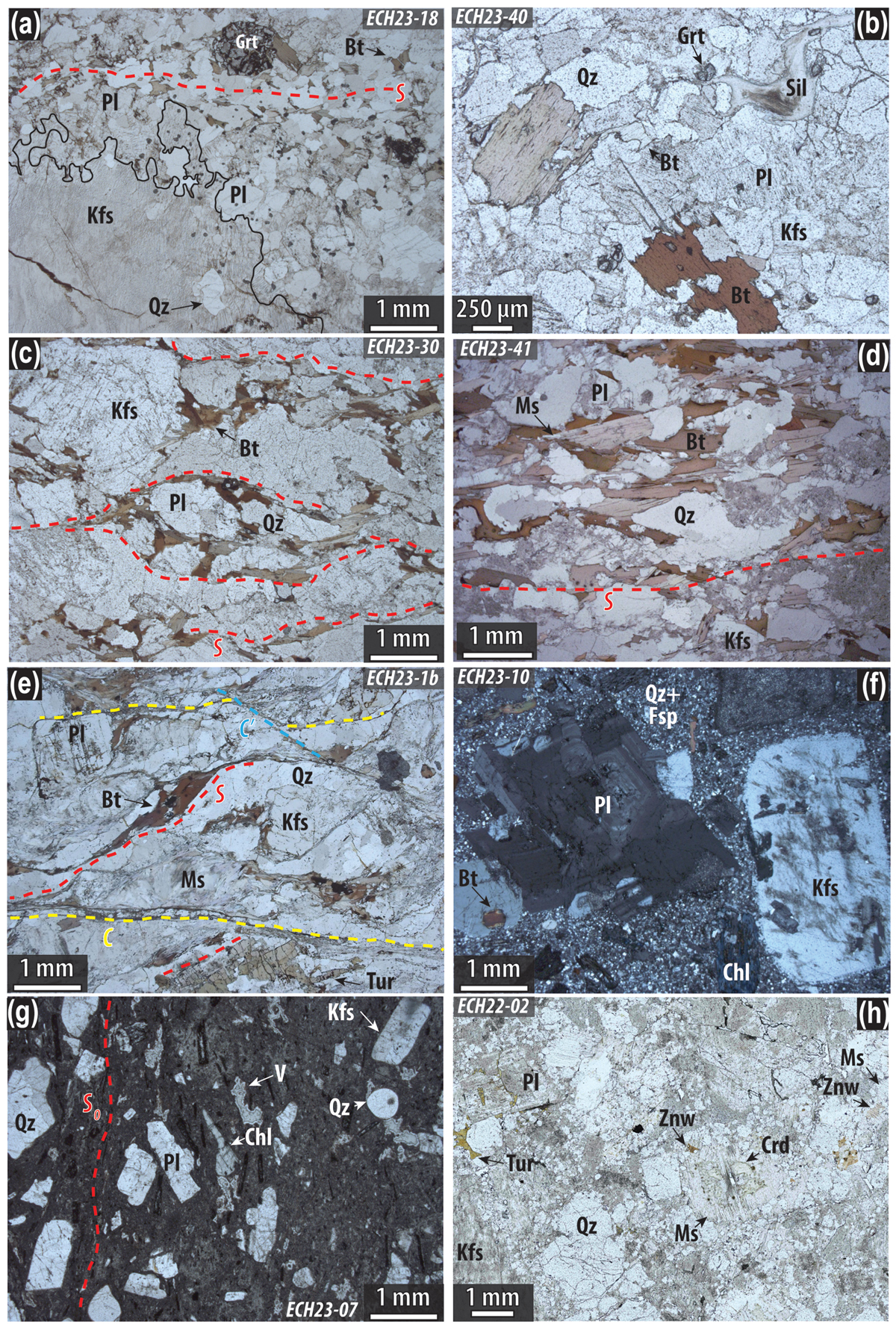
Petrographic and textural features of studied felsic (meta-)igneous rocks. (a-b) Migmatitic biotite-garnet ± sillimanite meta-leucogranites, with a perthitic K-feldspar phenocryst corroded by lobate quartz and plagioclase in (a). (c-d) Moderately deformed biotite granitoid from the Chantelle Massif (ECH23-30) and from a meter-sized igneous body in the Sioule Valley (ECH23-41). (e) Biotite-muscovite-tourmaline granite of the St-Gervais Massif displaying C/S fabrics and containing muscovite agglomerates interpreted as pseudomorphs after cordierite. (f) Porphyritic biotite microgranite of the Pouzol-Servant Massif, displaying phenocrysts and glomerocrysts of feldspar, quartz and biotite ± chlorite within a microgranular groundmass consisting of quartz and feldspar (cross-polarized light). (g) Trachy-dacitic ash flow tuff of the Châteauneuf Formation consisting of locally broken phenocrysts of quartz, feldspar and chlorite, vesicles (V) partially filled with mosaic quartz (possible devitrified glass shards) and an altered ground mass hosting aligned microlitic feldspar. Flow bedding (S0) is notably marked by altered, unidentified, black minerals. (h) Two-mica-cordierite granite of the Colettes Massif. Cordierite is partially replaced by gigantolite, an assemblage of zinnwaldite and muscovite, and zinnwaldite commonly cores muscovite flakes. Secondary tourmaline occurs as crack filling. Mineral abbreviation from Warr (2021).
Current usage metrics show cumulative count of Article Views (full-text article views including HTML views, PDF and ePub downloads, according to the available data) and Abstracts Views on Vision4Press platform.
Data correspond to usage on the plateform after 2015. The current usage metrics is available 48-96 hours after online publication and is updated daily on week days.
Initial download of the metrics may take a while.