


| Issue |
BSGF - Earth Sci. Bull.
Volume 197, 2026
Recent evolution of the Mediterranean realm: Exploring the links between deep and shallow processes in a plate convergent setting
|
|
|---|---|---|
| Article Number | 9 | |
| Number of page(s) | 16 | |
| DOI | https://doi.org/10.1051/bsgf/2026001 | |
| Published online | 28 avril 2026 | |
Structural inheritance within the outer zones of arcuate collisional orogens: A case from the Central-Northern Apennine orogenic system
1
Dipartimento di Scienze Fisiche, della Terra e dell'Ambiente, Universit`a degli Studi di Siena, Siena, 53100, Italy
2
Dipartimento di Ingegneria e Geologia, Università degli Studi 'G. D'Annunzio' di Chieti-Pescara, Chieti, 66100, Italy
3
PACE Geoscience, Chieti, Italy
* Corresponding author: Cette adresse e-mail est protégée contre les robots spammeurs. Vous devez activer le JavaScript pour la visualiser.
Received:
2
August
2024
Accepted:
31
December
2025
Abstract
The evolution of fold-and-thrust systems developed at the expenses of pre-orogenic extensional basins is mainly achieved by reactivation, truncation of precursor structures, or by variable combination of these two distinct modes of propagation of compressional deformation during positive tectonic inversion. An overview of three selected examples from the Central-Northern Apennines of peninsular Italy towards the nearby Adriatic foreland domain illustrates that reactivation, truncation or combinations of these two processes of precursor fault deformation tend to be dominant proceeding from forelands towards orogenic interiors, suggesting a correlation between modes of deformation during inversion and their spatial distribution across orogenic belts.
Key words: Tectonic inversion / Orogenic belts / Precursor extensional basins / Fault truncation / Reactivation / Structural inheritance
© E. Tavarnelli et al., Published by EDP Sciences 2026
 This is an Open Access article distributed under the terms of the Creative Commons Attribution License (https://creativecommons.org/licenses/by/4.0), which permits unrestricted use, distribution, and reproduction in any medium, provided the original work is properly cited.
1 Introduction
The advent of the Plate Tectonics theory in the 1970s has illustrated that compressional deformation fronts proceed from the inner orogenic provinces towards adjacent foreland domains (Dewey and Bird, 1970); in case of more-or-less linear converging continental margins, the deriving orogenic belts will consequently have more-or-less linear trends. There are, however, colliding continental blocks with margins far from linear, with highly pronounced salients and recesses, whose geometry does influence the final, complex shape of the growing mountain belts: isolated salients can thus represent a shared foreland domain with respect to distinct, converging orogenic systems flanking it from all sides. The Mediterranean area, due to the Cretaceous-to-Present interaction of small lithospheric plates (microplates: Alvarez et al., 1974) bounded by the main converging Africa and Eurasia plates, has long been considered a very complex tectonic puzzle; yet, thanks to good exposure, it has long represented a natural laboratory for the study of orogenic dynamics. The peri-Mediterranean belts originated from the Africa-Europe collision locally depart from ideally linear trends, especially around Adria, a northerly promontory of the African continent, that represents a common foreland domain shared by the Apennines, the Southern Alps and the Dinarides converging systems. Under these circumstances, it is important to investigate if − and, if so, to what extent − the occurrence of pre-existing structures within otherwise undeformed templates controls the final shape of convergent arcuate mountain belts (Fig. 1). In this contribution we aim at reviewing the evolution of the Northern-Central Apennines, an arcuate segment of the Apennine orogenic belt of peninsular Italy (Lavecchia et al., 1988; Calamita and Deiana, 1988; Billi and Tiberti, 2009), paying particular attention to the controls played by structures present in the Adria foreland as this was incorporated within the advancing orogenic wedge, an issue that has led to the development of the inversion tectonics concept (Williams et al., 1989; Coward, 1994). The arcuate map pattern of the Central-Northern Apennines has classically been interpreted as due to: paleogeographic dishomogeneities within the stratigraphy; the interaction of pre-and post-orogenic structures; the occurrence, thickness and lateral extent of detachment horizons mainly consisting of evaporite layers at the base of, or of pelitic layers within the sedimentary cover; and/or the distribution of gravity anomalies within the crust (Castellarin et al., 1982; Speranza and Chiappini, 2002; Billi and Tiberti, 2009; Barchi, 2010; Livani et al., 2018, and references therein). All these factors combined may help elucidate the geometry and deformation history of the stratigraphic sequences during positive tectonic inversion episodes. In the following sections we first review the basic definitions of inversion tectonics as this process was recognized in peninsular Italy and elsewhere, mainly in the circum-Mediterranean orogenic belts. We then describe three thrust-related anticlines reported from the literature, paying attention to the possible, if any, structural controls that have inhibited their location and amplification. Our examples, located in the Adria foreland and in the outer zones of the Central-Northern Apennines (Fig. 1), may ultimately provide sound analogues to model the evolution of analogue structures resulting from positive inversion in other belts of the circum-Mediterranean regions and elsewhere.
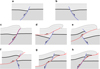 |
Fig. 1 A comprehensive review of 2D relationships between hinterland- (a) and foreland- dipping (b) precursor normal faults with subsequent thrusts and related folds (c-h). Hinterland-dipping normal faults may be reverse-reactivated (c), truncated (g), or reverse-reactivated to depth and truncated at higher structural levels (h) by upward-propagating thrusts. Foreland-dipping normal faults are generally truncated and passively carried piggy-back in the hangingwall blocks of upward-propagating thrusts (e, f), or may act as loci for thrust ramp nucleation (d). |
2 A short review of Inversion Tectonics concepts in the Central-Northern Apennines
Inversion tectonics is a significant, globally recognized process that applies to regions which have experienced a reversal in deformation regimes from extension to contraction or vice-versa. In the first case, basins developed during the extensional phase are turned inside out becoming structural highs or positive features. Basin-bounding normal faults may reverse their movement during superimposed contractional tectonics. This process accommodates ‘positive inversion’ also known as ‘basin inversion’ (Glennie and Boegner, 1981; Ziegler, 1987; Bally, 1984; Gillcrist et al., 1987; Williams et al., 1989; Letouzey, 1990; Coward, 1994; Buchanan and Buchanan, 1995). Conversely, a switch from compression to extension results in a change from uplift to subsidence leading to what is identified as ‘negative inversion’ (Glennie and Boegner, 1981; Harding, 1985; Cooper and Williams, 1989; Cooper and Warren, 2010; Tari et al., 2023). In this case, former thrusts produced during the compressional episodes may be reactivated as normal faults during the superimposed extensional phase.
At odds with classical concepts of inversion tectonics, resulting from switches in deformation fields, there is much less documentation available about inheritance played by structures developed under the same, or analogue, tectonic regime; these include, for instance, thrust-related folds whose final geometry was influenced by already existing compressional structures. The patterns of these interfering structures are relatively easy to recognize when they trend at high angles (e.g., Doglioni and Siorpaes, 1990), whereas their recognition may be more complex in case of interference of near-parallel structures.
Following the development of inversion tectonics concepts during the ‘80s and early ’90s, the Apennines of Italy increasingly attracted the interests of many researchers and remarkable examples of both positive and negative inversion tectonics were documented. Specifically, given the spectacular exposures and the mild overprint between repeated episodes of extension and contraction, the outer Central-Northern Apennines represent a natural laboratory to analyse different styles of inversion tectonics. Moreover, the Apennine thrust belt provides different exposure levels and sound stratigraphic constraints within the Meso-Cenozoic carbonate-dominated sequence. This feature makes it possible to understand and reconstruct how the boundary, passive continental margins of Tethys Ocean deformed under contraction. Therefore, widespread surface geological analyses, realistic stratigraphic templates and balanced cross-sections combined with diverse geophysical data led to the recognition of inversion and to the development of new tectonic models to account for these structures (see comprehensive reviews by Tavarnelli et al., 2004; Butler et al., 2006; Tavani et al., 2015). End-member, relatively simple “inversion anticlines” and “shortcut structures” have been described along with a great variety of more complex and composite structural patterns (e.g., Coward et al., 1999; Tavarnelli 1999; Mazzoli et al., 2002; Calamita et al., 2003; Tavarnelli et al., 2004; Butler et al., 2004; 2006; Centamore et al., 2009; Scisciani, 2009; Scisciani et al., 2014; Tavani et al., 2015; Pace et al., 2015; Calamita et al., 2018; Scisciani et al., 2019; Tavarnelli et al., 2019).
Such complex structural inversion tectonic styles have been documented in a wide range of scales in the outer sector of the Miocene-Pliocene Central-Northern Apennines, where newly-formed, gently-dipping thrusts variously interfere with different sets of pre-existing faults. Pre-thrusting normal faults were inherited from the early Mesozoic rifting, from the Miocene-Pliocene foreland flexuring ahead of the advancing thrust belt, or from a combination of both mechanisms. Significant lateral thickness and facies variations within the pre-orogenic, Jurassic-Eocene stratigraphy are related to the syn-sedimentary Jurassic rifting (Centamore et al., 1969, 1971; Colacicchi et al., 1970; Alvarez, 1990; Santantonio, 1993; Bosellini, 2004) and to the Cretaceous-Paleogene normal faulting episodes (Baldanza et al., 1982; Decandia, 1982; Montanari et al., 1989). In addition, syn-flexural, yet pre-thrusting normal fault systems of Miocene age controlling the development of the depocentres and of the outer edges of syn-orogenic basins have also been reported (e.g., Calamita et al., 1998, 2003; Scisciani et al., 2001; Mazzoli et al., 2002). From Middle-Late Miocene onward, following the onset of the orogenic regime, the switch in deformation from extension to contraction led to positive inversion. As a consequence, all normal faults of Jurassic, Cretaceous-Paleogene and Miocene ages within the pre-thrusting template were modified by upward-propagating thrusts and related folds of Messinian-Lower Pliocene age. The most frequently documented modification by late propagating thrust faults across previously extended templates include reactivation, rotation, truncation and/or passive translation of pre-thrusting normal faults (e.g., Tavarnelli, 1996; Scisciani et al., 2001; Calamita et al., 2018), largely depending on the orientation of the former structures with respect to the subsequent contractional stress field (Calamita et al., 2011). Generally, the inherited normal fault-controlled templates exerted a strong control on thrust ramp nucleation (e.g., Tavarnelli, 1996). Oblique thrust ramps, corresponding to important NNE-SSW-trending regional-scale cross-striking discontinuities, resulted from the transpressional reactivation of precursor basement-rooted faults, giving rise to thrust belt compartmentalization, segmentation and curvature (e.g., Tavarnelli et al., 2004; Butler et al., 2006; Satolli et al., 2014; Barchi and Tavarnelli, 2022). Contrasting styles of positive fault reactivation (i.e., reverse reactivation or footwall thrust shortcut) are documented along the NW-SE-striking low-angle frontal thrust ramps and along the NNE-SSW-striking high-angle oblique thrust ramps (Calamita et al., 2011).
Furthermore, the NW-SE-trending pre-thrusting normal faults that had experienced positive inversion, having been reverse-reactivated to depth and passively carried piggy-back in the hanging-wall of shortcut anticlines at or near the surface, are occasionally recording negative inversion following the onset of the seismogenic Quaternary extensional stress field along the backbone of the Apennines (e.g., Calamita et al., 2003, 2011; Tavarnelli et al., 2004; De Paola et al., 2006; Pizzi and Galadini, 2009; Di Domenica et al., 2012; Pizzi et al., 2017; Porreca et al., 2020).
Re-examining the structural evolution of the outer parts of the Northern Apennines, Coward et al., (1999) reviewed the role of structural inheritance with extension of inversion tectonics concepts also to deeper crustal levels. This opened a new scenario, with changed the interpretation of: i) the deep structure of the thrust belt, from popular detachment-dominated thin-skinned models, largely applied during the 1980s (e.g., Bally et al., 1986; Hill and Hayward, 1988), to more conservative thick-skinned models (e.g., Barchi et al., 1998) only involving basement fault reactivation (e.g., Mazzoli et al., 2000; Butler et al., 2004; Tavarnelli et al., 2004; Calamita et al.; Scisciani et al., 2014, 2019; Tavarnelli et al., 2019); and ii) to combinations of detachments located at the base of, and also within the sedimentary cover, locally interfering with deeper faults emanating from the basement that have been reverse-reactivated (Ghisetti et al., 1993; Barchi and Tavarnelli, 2022).
3 Examples of structural controls in the outer Central-Northern Apennines and in the Adriatic offshore
In the following sections we present the results of investigations carried out along three distinct structures that have been extensively described in a wide literature; two are located in the outer zones of the Central-Northern Apennines and one in the adjacent Adriatic foreland domain offshore (Fig. 2). In order to evaluate possible controls in the development of these structures, we proceed from east to west, i.e., from the relatively less deformed Adria foreland domain toward the more intensely deformed interiors of the outer zones of the Central-Northern Apennines thrust system. The first structure corresponds to the Mid-Adriatic Ridge, offshore the Marche coastline; the second structure corresponds to the Montagna dei Fiori Anticline; and the third structure is described along the Mt. Sibillini Thrust (Figs. 2a and 2b).
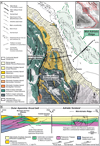 |
Fig. 2 (a) Simplified structural-geological and related composite geological cross-section (b) of the outer Neogene-Quaternary Central-Northern Apennine fold-and-thrust belt and the doformed sector of the Adriatic foreland (modified after Calamita et al. 2021). Please note that the cross-section (b) does not balance: the impossibility to obtain a restored template, essential requirement for balanced cross-sections, is due to the lack of data in the deep parts of the A1-A2 tract (area indicated as “no data”), that prevents to locate footwall cutoff points for the Carbonate succession unit. |
3.1 − The Mid-Adriatic Ridge
Seismic data from the Marche offshore illustrate the occurrence of a positive compressional structure located midway between the coastlines of Italy and Croatia on both sides of the Adriatic Sea (Figs. 2 and 3). This positive structure, bounded by a system of SW- and NE-dipping high-angle reverse faults, has long been known to the scientific community as the Mid Adriatic Ridge (Figs. 2 and 3).
Stratigraphic data indicate that the Mid-Adriatic Ridge was uplifted during the latest Cretaceous-Miocene time interval, matching with the deformation events that collectively are indicated to correspond to the Dinaric Phase (e.g., Schmid et al., 2008; Porkoláb et al., 2019; Calamita et al., 2021). This contractional high-angle reverse fault system developed within the Adriatic foreland ahead of the growing, SW-propagating Dinaric chain (Fig. 3), consists of two main NW–SE trending high-angle reverse faults along which a 5-8 thick succession of marine, Triassic-to-Tertiary rocks are uplifted to define an upward-extruded wedge. This structure is not the only compressional feature recognized within the otherwise less deformed Adria Promontory. Indeed, it seems relevant to stress that evidence for SW-directed, compressional structures belonging to the Dinaric system have long been reported from the eastern margin of the Adriatic Sea and along its north-west ward lateral continuation in the Southern Alps (Doglioni and Siorpaes, 1990); moreover, minor evidence for a further westward extension of SW-directed compressional deformations of Tertiary age is also documented in the Gargano Promontory of Southern Italy (Bertotti et al., 1999). Therefore, it seems likely that the effects, though mild, of the Dinaric Phase are diffused within much of the Adriatic offshore domain.
Pace et al. (2015) have described the Mid Adriatic Ridge whose deep geometry is inferred from high-resolution seismic profiles. The occurrence of facies and thickness variations within Triassic-Lower Cretaceous rocks west of the Mid Adriatic Ridge is controlled by syn-sedimentary normal faults that were active prior to the onset of the Dinaric contractional deformations (Fig. 3). Many of the high-angle faults bounding the Mid Adriatic Ridge and within it exhibit evidence for thickness inversion across them at null-points (terminology after Cooper and Williams, 1989), an evidence indicating that many of these structures were originated as Triassic-Lower Cretaceous syn-sedimentary normal faults. These faults were later reverse-reactivated to produce the observed upward extrusion of Upper Cretaceous-Miocene sequences during the Dinaric Phase (Fig. 3). These relationships apply to the Dinaric up-thrust (DUT in Fig. 3) that limits the Mid Adriatic Ridge westwards. It is interesting to note that all reverse-reactivated normal faults fall within the Mid Adriatic Ridge, whereas those west of it do not exhibit evidence for reverse reactivation, maintaining normal offsets. This dual behaviour likely reflects the occurrence along the Mid Adriatic Ridge of deep normal faults emanating from the basement that produced significant offsets within parts of the overlying sedimentary cover sections. These observations and inferences suggest that the location of the Tertiary Mid Adriatic Ridge was controlled by syn-sedimetary normal faults, some of which emanating from the basement, that were reverse-reactivated during the Upper Cretaceous-Miocene contractional events. This inference supports the view of structural inheritance phenomena during the Dinaric Phase.
Careful examination within the upper part of the Mid Adriatic Ridge illustrates two West-dipping normal faults affecting and controlling thickness and facies variations within Pliocene-Quaternary deposits. These faults show no evidence for reactivation, indicating that when they formed the compressional effects of the Dinaric Phase had long waned (Fig. 3).
3.2 The Montagna dei Fiori thrust-related anticline
The Montagna dei Fiori Anticline is the most prominent structure in the outer Central-Northern Apennine fold-and-thrust belt, and consists of a NNW–SSE-trending, thrust-related fold (Figs. 2 and 4).
The anticline is East-verging and is exposed for an along-strike length of c. 25 km. The fold profile is remarkably asymmetric, with a steep-to-overturned forelimb and a gently (30–50°) dipping backlimb, separated by a flat-lying crest zone and by a curvilinear hinge line plunging NNW- and S-wards (Fig. 4). The fold-and-thrust structure involves the pre-orogenic, Jurassic–Miocene, Umbria–Marche pelagic carbonate sequence overlain by Messinian syn-orogenic, foredeep siliciclastic deposits of the Laga Formation (Giannini, 1960; Giannini et al., 1970; Koopman, 1983; Mattei, 1987; Calamita et al., 1998; Scisciani et al., 2001; Scisciani and Montefalcone, 2006; Di Francesco et al., 2010; Storti et al., 2018).
The main thrust surface, exposed in the fold core, is antiformally folded by the growth of a younger and deeper thrust-related anticline, as inferred from several interpretations of seismic reflection profiles (Bally et al., 1986; Ghisetti and Vezzani, 2000; Scisciani and Montefalcone, 2006; Artoni, 2013; Figs. 4a and 4c). Moving eastwards, a gently West-dipping thrust propagates across East-dipping siliciclastic deposits of the Messinian Laga Formation (Calamita, 1990; Scisciani and Montefalcone, 2006). The steeply East-dipping to overturned forelimb of the Montagna dei Fiori Anticline trends NW–SE in the northern sector, changing across the fold axial culmination to a N–S orientation. Pervasive S-C-C’ fabrics within shear zones along the thrust that truncates the fold forelimb consistently indicate a top-to-the-NE (60–70° N) tectonic transport direction (Koopman, 1983). Reverse shear zones and detachment folds are also exposed in the anticline backlimb. The shear zones are confined to the upper section of the Miocene marly sequence, whereas the overlying Messinian turbidites (i.e., Laga Formation) appear undeformed (Koopman, 1983; Invernizzi and Ridolfi, 1992; Calamita et al., 1998; Mazzoli et al., 2002; Scisciani and Montefalcone, 2006). The similarity between the geometries and kinematics of the shear zones observed along the flanks of the Montagna dei Fiori Anticline indicates that the Palaeogene–Miocene pre-orogenic succession acted as a regional detachment level (Laga Detachment sensu Koopman, 1983), along which the thick sedimentary wedge of the Laga Formation was translated eastwards with respect to the underlying Mesozoic sequence. The deep (> 10 km) setting of the Montagna dei Fiori structure has been debated by many authors, and both thin- and thick-skinned tectonic models have been used to illustrate the tectonic style of this sector of the outer Central-Northern Apennines (Paltrinieri et al., 1982; Bally et al., 1986; Tozer et al., 2002, 2006; Albouy et al., 2003; Scisciani and Montefalcone, 2006).
The crest of the Montagna dei Fiori Anticline is offset by a steeply SW-dipping normal fault, the Montagna dei Fiori Fault, along which the Miocene Marne con Cerrogna Formation of the hanging-wall is juxtaposed to the pre-orogenic carbonate sequence with an offset of ca. 900m (Mattei, 1987; Calamita et al., 1998; Scisciani et al., 2001; Fig. 4b). The timing of activity of the Montagna dei Fiori Fault with respect to the orogenic deformation event is highly controversial and different interpretations have been proposed. Based on the assumption that the vast majority of normal faults affecting Jurassic-Neogene stratigraphic sequences in the Apennines result from late-to-post-thrusting extension, Koopman (1983), Bally et al. (1986) and Mattei (1987) consider the fault as a post-orogenic structure; Ghisetti and Vezzani (2000) and Storti et al. (2018), the latter based on geochemical data from veins associated with the main extensional structures, propose that the activity of the Montagna dei Fiori Fault accompanied, and thus was synchronous with, thrusting; and conversely, at odds with other abovementioned interpretations, Calamita et al. (1998), Scisciani et al., 2001, Mazzoli et al. (2002) and Tozer et al., (2006), based on the occurrence of minor thrusts that accommodate few centimetres of contractional displacements and that truncate the main normal fault surface, consider the Montagna dei Fiori Fault as a pre-thrusting structure, whose development would have accommodated foreland flexuring, the location of the Laga Foredeep Basin and whose occurrence would have inhibited foreland-directed thrust propagation (Fig. 4b).
In more recent accounts, the opening and evolution of the Tyrrhenian Sea to the west of the Apennines has been interpreted as due to, and accompanied by, lithospheric stretching accommodated by subsidence within basins bounded by normal faults that merge downwards into low-angle extensional detachments: these structures have since been referred to as supradetachment faults (Milia and Torrente, 2015; Milia et al., 2017). Consistently with this interpretation, and as a possible alternative to pre-thrusting extension due to foreland flexuring and foredeep development ahead of the advancing Apennine belt (Scisciani et al., 2001; Mazzoli et al., 2002; Tozer et al., 2006) we here propose that the formation of the Montagna dei Fiori Fault could result from location of a supradetachment extensional basin, developed since the Middle-Late Miocene, and later affected by thrusting of Upper Messinian age during its incorporation in the Apennine belt.
Even more recently, Calamita et al. (2021) propose a different model predicting that the fault represents an originally, steeply NE-dipping, SW-propagating high-angle up-thrust of Teriary age developed during the Dinaric Phase (Fig. 4e); this upthrust would have later been truncated by the NE-propagating Montagna dei Fiori Thrust and rotated to its current SW-dip, that consequently mimics the geometry of a normal fault.
Given the documented occurrence of small low-angle thrusts offsetting the main fault surface − and regardless of the pre-thrusting fault origin as due: i) to foreland flexure (Calamita et al., 1998; Scisciani et al., 2001; Mazzoli et al., 2002; Tozer et al., 2006); ii) to a supradetachment basin-driven process (terminology after Milia and Torrente, 2015; this study); or alternatively: iii) to the Dinaric up-thrust (Calamita et al., 2021) interpretation − we here maintain that the steeply dipping fault running along the crest line of the Montagna dei Fori Anticline predated its growth, juxtaposing rocks with different rheological properties. We conclude that this inherited structure represented a fundamental geometrical and mechanical control on the development of the Montagna dei Fiori thust ramp during the Apennine orogenic event.
3.3 The Mt. Sibillini Thrust
The Mt. Sibillini Thrust is a prominent, first-order arcuate structure representing the main front of the Central-Northern Apennines belt (Calamita and Deiana 1988). The thrust consists of a NW-SE-trending segment deviating into a N-S and then NNE-SSW trend, respectively north, east and south of Mt. Vettore (Figs 2, 4 and 6).
The thrust is traced continuously for over 150 km and is characterized by a maximum displacement of ca. 10 km achieved in the salient apex zone near Mt. Vettore (Mazzoli et al., 2005; Pierantoni et al., 2005; Pierantoni et al., 2013) progressively decreasing towards the NW and SSW. Well-developed kinematic indicators, namely S-C-C’ fabrics and R-R’ Riedel shears, reveal a N60−70° mean tectonic transport direction, defining for the thrust a frontal ramp geometry to the north, and an oblique-lateral ramp geometry to the south (e.g., Calamita et al., 1987; Bigi et al., 1995; Pace et al., 2017, 2022a, b). The thrust hanging-wall and footwall, along with the thrust surface itself, are antiformally folded. In the thrust hanging-wall, folds have an axial trend running parallel to the thrust system orientation, while some NW-SE folds are developed in the footwall (Koopman 1983; Calamita and Deiana 1988). To the south of Mt. Vettore, the NNW-SSE footwall anticlines involve also the NNE-SSW-trending oblique thrust ramp surface and the hanging-wall anticlines, indicating a general piggy-back, hinterland-to-foreland thrust propagation sequence (e.g., Calamita et al., 2012). Along the NNE-SSW-trending segment, the Neogene oblique-lateral thrust ramp surface transpressionally reactivated a pre-existing normal fault system of Lower Jurassic age (Calamita and Deiana 1988; Tavarnelli, 2004; Butler et al., 2006; Calamita et al., 2011; Pace and Calamita 2014). This Lower Jurassic normal fault system (i.e., Ancona-Anzio Line, Castellarin et al., 1982) acted as a regional paleogeographic boundary separating the Mesozoic Latium-Abruzzi carbonate platform from the Umbria-Marche pelagic domain (Figs. 2a, 2b, and 5a). The pre-orogenic, Mesozoic-Tertiary platform-to-basinal limestones, marly limestones, and marls are thrust onto the Messinian syn-orogenic siliciclastic foredeep deposits of the Laga Fm. along the salient apex segment of the Mt. Sibillini Thrust.
Regional-scale faults, corresponding to 15-35 km-long, NW-SE-striking high-angle segmented normal fault arrays, affect the carbonate ridge of the thrust belt both in the hanging-wall (Figs. 2 and 6a) and in the footwall of the Mt. Sibillini Thrust (Pizzi and Galadini 2009; Di Domenica et al., 2012). Detailed mesoscopic structural analyses carried out along these faults (Figs. 2 and 6a) illustrate their pre-thrusting activity (e.g., Pizzi and Galadini 2009; Di Domenica et al., 2012; Calamita et al., 2018). Some of these NW-SE-trending inherited normal fault arrays were reactivated during the post-orogenic, ENE-directed Quaternary extension. This reactivation process was responsible for controlling the distribution of the seismicity along the axial zone of the thrust belt and locally truncated and offset the NNE-SSW-trending Mt. Sibillini oblique thrust ramp, as highlighted during the strong (Mw 6.5) 2016 seismic sequence (Pizzi et al., 2017; Porreca et al., 2020).
The present geometry of the Mt. Sibillini Thrust, therefore, results from a double switch in deformation regimes, with an episode of positive inversion followed by an episode of negative inversion. During positive inversion, the main NW-SE-trending pre-orogenic normal faults mapped north of the Mt. Vettore apex were reverse-reactivated to depth, whilst they were truncated and carried piggy-back towards the foreland along the frontal ramp portion of the Mt. Sibillini Thrust, defining a short-cut fault geometry (Figs. 5b, 6c, and 6d; Pace et al., 2022a, b). At odds with this dual behaviour along the main Mt. Sibillini frontal thrust ramp north of Mt. Vettore, with fault reactivation to depth and fault truncation in more elevated parts of the section, the NNE-SSW-trending normal faults south of the Mt. Vettore apex (Fig. 2a) were almost entirely transpressionally reactivated, to define the Mt. Sibillini oblique-lateral thrust ramp along the so-called Ancona-Anzio Line (Castellarin et al., 1982) or the Olevano-Antrodoco-Sibillini lateral thrust front (terminology after Salvini and Vittori, 1982; Figs. 2a and 5b). This duality of patterns indicates that the pre-orogenic architecture of the extensional fault array significantly influenced and controlled the geometry of the superimposed, up-propagating thrust surface during positive inversion. The main controlling factors for fault reacticvation appear related to pre-orogenic fault orientation and dip (Fig. 2a) whereas a possible additional control exerted by the occurrence, thickness and lateral extent of evaporites to depth remains speculative. The frontal ramp was produced at the expenses of a WSW-, hinterland-dipping, pre-orogenic normal fault with listric geometry, whose deep part was easily reactivated due to its favourable orientation during subsequent thrusting, whereas the steeper, upper part was trimmed by thrusting and passively carried piggy-back in the thrust hanging-wall block. As a consequence, the fault reactivation process took only place to depth along the frontal ramp. At odds with this mode of inversion, the SSW-NNE pre-orogenic extensional faults south of Mt. Vettore, trending at a small angle with respect to the dominant N60°−70° thrusting direction, were almost entirely transpressionally reactivated resulting in the development of an oblique-lateral thrust ramp segment (Fig. 2a). It appears that the geometry, map pattern and orientation of pre-orogenic extensional faults exerted a role in defining the reactivation vs. truncation styles during the positive inversion event responsible for the development of the Mt. Sibillini Thrust. Similarly, during negative inversion, several parts of the Mt. Sibillini Thrust were extensionally reactivated (Di Domenica et al., 2012), indicating that the orogenic architecture achieved during the construction of the Apennine belt, in turn, played a role in focussing the location and current geometry of post-orogenic normal faults responsible for the diffuse seismicity in the area.
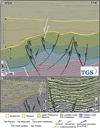 |
Fig. 3 (a) Seismic section from the Mid-Adriatic Ridge (location in Fig. 1) showing a polyphase inversion structure composed of several Dinaric up-thrusts (DUT) and related folds having an Upper Cretaceous-Oligocene (growth coeval with the onset of the Dinaric foreland contractional deformation and a later reactivation during the Pliocene-Quaternary Apennine phase. (b and c) Close-ups of the seismics with the cosine of phase attribute showing the two phases of growth and inversion (modified after Pace et al., 2015 and Calamita et al., 2021). |
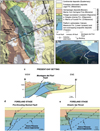 |
Fig. 4 (a) Geological map of the Montagna dei Fiori structure (modified from Mattei, 1987; Calamita et al., 2011). (b) Panoramic view of the Montagna dei Fiori fault along the forelimb/hinge zone of the anticline, showing the attitude of the footwall strata characterized by 30−40° dip towards the NE. (c) Geological cross-section (trace B-B’ in Fig. 4a). (d) Speculative template showing the interpretation of the Montagna dei Fiori Fault as a syn-orogenic, pre-thrusting normal fault (Calamita et al., 1998; Scisciani et al., 2001). (e) Speculative template showing the interpretation of the Montagna dei Fiori Fault as a NE-directed, high-angle upthrust (DUT) developed during the latest Cretaceous–Middle Miocene time interval (Calamita et al., 2021). Note that the cross-section (c) does not balance, due to the paucity of data to constrain its deeper parts, which prevents its quantitative restoration; however, it is presented here with the only purpose of illustrating the alternative, qualitative interpretations given for the same structure, the Montagna dei Fiori Fault, as a pre-thrusting normal fault (d) or as a West-directed upthust (e). One slightly different, third interpretation for the Montagna dei Fiori Fault, that is yet geometrically and kinematically consistent with the hypothesis of a pre-thrusting normal fault illustrated in Figure 4d, is that this tructure could represent the relicts of a supradetachment fault (terminology after Milia & Torrente, 2015), inherited during the episodes of extension that have accompanied the opening of the Tyrrhenian Sea and preceeded the upward-propagation of the Montagna dei Fiori Thrust (see the text for explanation). |
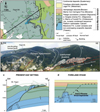 |
Fig. 5 Schematic 3D block diagrams illustrating the main structural controls of extensional fault arrays on thrust ramp propagation, resulting in the development of frontal and of oblique-lateral ramps depending on the orientation of precursor faults with respect to the superimposed direction of thrust tectonic transport (inspired to the case of the Olevano-Antrodoco-Mt. Sibillini Thrust. (a) Pre-thrusting template; (b) Thrust distribution as it results from the onset and evolution of orogenic contraction. U-M-S: Umbria-Marche-Sabina Basin; L-A: Latium-Abruzzi Platform; OTR: Olevano Thrust; OAS: Olevano-Antrodoco oblique-lateral thrust ramp; FTR: Mt. Sibillini frontal thrust ramp. |
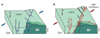 |
Fig. 6 Schematic 3D block diagrams illustrating the main structural controls of extensional fault arrays on thrust ramp propagation, resulting in the development of frontal and of oblique-lateral ramps depending on the orientation of precursor faults with respect to the superimposed direction of thrust tectonic transport (inspired to the case of the Olevano-Antrodoco-Mt. Sibillini Thrust. (a) Pre-thrusting template; (b) Thrust distribution as it results from the onset and evolution of orogenic contraction. U-M-S: Umbria-Marche-Sabina Basin; L-A: Latium-Abruzzi Platform; OTR: Olevano Thrust; OAS: Olevano-Antrodoco oblique-lateral thrust ramp; FTR: Mt. Sibillini frontal thrust ramp. |
4 Variability of structural inheritance during inversion: a discussion
Pre-existing faults, shear zones or other heterogeneities may be modified in two end-member modes during positive inversion: reactivation and truncation (Butler, 1989; Tavarnelli, 1999; Butler et al., 2006). The three main structures − the Mid-Adriatic Ridge, the Montagna dei Fiori Anticline and the Mt. Sibillini Thrust − described in the previous sections illustrate different controls exerted by heterogeneities in the Adria foreland domain as this experienced orogenic contraction.
The Mid-Adriatic Ridge was mainly achieved by reverse-reactivation of syn-sedimentary, pre-orogenic normal faults that had controlled thickness and facies variability during deposition of the Meso-Cenozoic stratigraphic sequences within the Adria foreland domain. Most of these faults were reverse-reactivated as Adria experienced compression due to the onset of the Dinaric and of the Apennine orogenic events on its eastern and western margins, respectively, showing that the fault reactivation process plays a fundamental role during positive inversion in foreland domains. These relationships, first documented by Pace et al. (2015), are confirmed in this study.
The Montagna dei Fiori Anticline, west of the Mid-Adriatic Ridge, illustrates more complex structural patterns, mainly driven by truncation (associated, or not, to simple shear components) of pre-existing faults during thrust propagation. The steeply-dipping Montagna dei Fiori Fault running along the crest line of the main anticline was modified as orogenic compressional deformation progressively affected the foothills zone of the Central-Northern Apennines. This steeply-dipping fault may have had an original extensional character (Fig. 4d) and could have developed in the Late Messinian during foreland flexuring ahead of the advancing Apennine deformation front. The normal fault would have been later truncated and carried piggy-back by the NE-propagating Montagna dei Fiori thrust, as proposed by Calamita et al. (1998), Scisciani et al. (2001) Mazzoli et al. (2002) and Mazzoli et al. (2002). Alternatively, the fault could have developed as an original, steep up-thrust of Late Tertiary age during the southwestward migration of the Dinaric orogenic front (Fig. 4e); it may then have been tilted due to simple shear and truncated by the NE-propagating Montagna dei Fiori thrust during the subsequent onset of the Apennine orogenic event maintaining high cutoff angle relationships with bedding, to mimic an apparent extensional character, as more recently proposed by Calamita et al. (2021). Either way − foreland extensional faulting or SW-directed up-thrusting, followed by NE-directed low-angle thrusting − the Montagna dei Fiori Thrust and related anticline provide an example to illustrate that fault truncation represents an effective mode to accommodate thrusting across heterogeneous foreland domains. Both interpretations (SW-dipping, foreland-flexure induced pre-thrusting normal fault, or high-angle, SW-directed Dinaric Upthrust thrust later tilted to mimic a high-angle SW-dipping normal fault) are consistent with the available documentation and thus represent viable solutions. However, given that recent interpretation of seismic lines across the Mid-Adriatic Ridge reveals hig-angle upthrusts induced by the SW-directed migration of the Dinaric orogenic front (Pace et al. (2015)), in this contribution we favour and support Calamita et al. (2021)’s view of the Montagna dei Fiori Fault as a Dinaric upthrust later affected by a younger NE-directed thrust during the easterly propagation of the Apennine deformation front.
The Mt. Sibillini Thrust west of the Montagna dei Fiori Anticline and the most internal structure of the outer zones of the Central-Northern Apennines investigated in this contribution, illustrate yet more complex structural patterns with respect to the more external, easterly examples. North of Mt. Vettore the Thrust frontal ramp reactivated the lower part of a presumably listric, hinterland-dipping pre-orogenic normal fault, yet truncating its upper section to produce a short-cut thrust geometry (Calamita et al., 2012). On the other hand, south of Mt. Vettore, the Thrust oblique-lateral ramp transpressionally reactivated the SSW-NNE trending pre-orogenic normal fault, with little or no evidence for fault truncation phenomena (Pace and Calamita, 2014; Di Domenica et al., 2014). It appears that the arcuate geometry of the Mt. Sibillini Thrust was controlled by the attitude, pattern, geometry and orientation of pre-orogenic extensional faults within the pre-thrusting template. More recently, Pace et al. (2022a) have shown that an additional control on the final geometry of the Mt. Sibillini Thrust might have been represented and played by the displacement distribution along the pre-thrusting extensional faults, that may have been hard- or soft-linked, respectively (see Fig. 13 in Pace et al. (2022a)). Under these circumstances, the structures within the transition zone between the shortcut-related frontal thrust ramp, to the north, and the reactivation-related oblique thrust ramp, to the south, may help discern if, and to what extent, the pre-thrusting extensional faults were hard- or soft-linked, representing a single fault with an original arcuate geometry, or two separate, more linear fault segments with different trends whose growth by coalescence produced a more complex arcuate pattern. Either way, it appears that the evolution of the Mt. Sibillini Thrust during positive inversion related to the onset of the Apennine orogenic event was characterized by structural control variability, resulting in combinations of reactivation and truncation patterns of pre-thrusting extensional faults.
The results illustrated above from the Central-Northern Apennines of Italy, the Marche Foothills and the Adriatic Foreland domains (e.g., see Bigi et al., 2012; this study) can be compared and contrasted with those from other areas that have experienced positive tectonic inversion in other provinces of the Apennine-Maghrebide system, such as those widely described in central and southern Italy (Roure et al., 1990; Mazzoli et al., 2000; Calabrò et al., 2003; Mazzoli et al., 2000), in the northernmost part of Adria around the southern Alps (Casero, 2004; Cassinis et al., 2008), in Sicily and in the North African margin (Casero et al., 1991; Roure et al., 2012, and references therein). As for the foreland domains ahead of the Apennine belt in the Adriatic offshore, the most common and extensively documented examples of positive inversion illustrate a simple reverse-reactivation of pre-contractional normal faults with consequent upward graben extrusion phenomena (e.g., Argnani and Gamberi, 1995). Proceeding from the foreland domains towards the orogenic interiors of the Apennine belt in peninsular Italy, the recognition of structures due to positive inversion tends to be progressively more complex (e.g., Butler et al., 2006).
One relevant aspect regarding the deep structure of the Apennine focusses on the deformation style, that has been alternatively interpreted in terms of thin-skinned (Bally et al., 1986) or thick-skinned (Speranza and Chiappini, 2002) models, or of various combinations of both styles (Mazzoli et al., 2000; Calabrò et al., 2003; Barchi and Tavarnelli, 2022). Regardless of the real deep geometry of the belt, that is still poorly constrained having led to different and often contrasting interpretations, of particular interest in comparing the geometries of structures resulting from positive inversion within the Apennines is a terminology issue: while the use of a thick-skinned style in the central-northern parts of the belt describes the upward extrusion of Permo-Triassic basins that involve slices of the underlying Hercynian basement (Pace et al. (2015); Tavarnelli et al., 2019), the use of thick-skinned concepts in southern Italy mainly illustrates the upward extrusion by thrusts reverse-reactivating pre-orogenic normal faults developed across relevant parts of a carbonate platform of Mesozoic-Tertiary age (the so-called “Apulian belt” by Cello and Mazzoli, 1999; Scrocca et al., 2005), thus limited to the tectonically buried parts of the sedimentary cover, yet with little information on the involvement (or not) of underlying basement slices.
The interest in the tectono-sedimentary setting and on the deep structure of the Apennine-Maghrebide system, especially in terms of the controls played by inherited structures during positive inversion, has further increased starting from the 1980s with an extensive exploration campaign, since the belt and the adjacent Adriatic-African foreland domains have been recognized and exploited as important petroleum plays (Bally et al., 1986; Roure et al., 1990, 2012; Casero, 2004; Patacca and Scandone, 2004; Casero and Bigi, 2013). These studies, some of which investigate lithospheric-scale processes, have outlined the prominent role of reverse-reactivation of pre-orogenic normal faults during the transition from inherited rifting to mountain building, yet with some documented local deviation with examples of pre-thrusting normal faults truncated by upward-propagating thrusts, especially located in the deeply buried parts of the outer provinces and of the adjacent foreland domains.
In addition to studies from the Apennines, other remarkable examples of positive inversion have been widely reported from Europe, North Africa and are particularly abundant in the peri-Mediterranean belts. Examples from continental Europe include the North Sea, the East Shetland Platform and other provinces of the UK, with cases of partial reverse-reactivation of normal faults described by Bally (1984), Corfield et al. (1996), Platt and Cartwright (1998), Connolly et al. (2024) and also by De Paola et al. (2005), although the latter interpreted these reactivated structures in terms of transtensional, rather than inversion-induced deformations.
Further examples of positive inversion in many peri-Mediterranean belts, such as the Pyrenees, the Alps, the Dynarides, the Carpathians, the Albanides, the Hellenides, the Maghrebides and the Kabylides, involve not only simple fault reactivation, but also different and even more complex modifications of pre-thrusting normal faults (e.g., Roure et al., 1989, 1990, 2004, 2012; Butler et al., 2006; Van Unen et al., 2019; Tari et al., 2020; Soto et al., 2024; Zelilidis et al., 2024, and references therein). From a historic point of view, the French Alps have played a fundamental role in the study of inversion tectonics. A spectacular array of pre-orogenic normal faults preserved at the level of the basement-cover contact is reported from the Ecrins region (Lemoine et al., 1986). In a seminal study, Gidon (1981) illustrated that the pre-thrusting normal faults affecting the basement did not only reactivate as thrusts, but also served to partition thrust-related compression into zones of dominantly vertical stretching within mechanically and rheologically weak layers located at different levels within the overlying sedimentary cover, a behaviour that has since been referred to as “buttressing” (Gillcrist et al., 1987). As a consequence, De Graciansky et al. (1989) suggest that many of the Mesozoic basins bounded by pre-thrusting normal faults, well exposed in the Ecrins region, have been penetratively shortened by buttressing during the Alpine inversion. Other examples of complex structures due to positive inversion at a regional scale, specifically interpreted as buttressed pre-thrusting extensional basins with half graben geometry, have been reported in the northern flank of the Aar massif in the central Swiss Alps (Butler and Mazzoli, 2006; Butler et al., 2006).
In summary, one very common feature recognized in many collision belts in the peri-Mediterranean domain due to positive inversion is that, proceeding from the outermost parts towards the orogenic interiors there appears to be a tendency towards progressively complex structural relationships, where simple normal fault reverse-reactivation phenomena dominate in the foreland and outer zones. On the other hand, reactivation of late thrusts at the expenses of pre-existing normal faults bounding precursor basins, although potentially present and important, tends to be sequentially obscured. This is probably due to combinations of factors including, but not necessarily restricted to, pervasive shearing, mechanical-rheological properties and presence or absence of fluids during deformation as dominant tectonic controls within orogenic interiors (e.g., Butler et al., 2006).
Most thrust belts mentioned in this discussion share all the features outlined above (Fig. 7). On the other hand, one feature that appears peculiar of the Outer Zones of the Central-Northern Apennines, and in particular of its western sector, is the common occurrence of formerly foreland-, i.e., east-dipping pre-thrusting faults (be these normal faults or early back −thrusts) that were basculated and/or partly folded to acquire a westerly dip, prior to be reactivated or truncated and passively carried piggy-back within east-directed, regionally important thrust-bounded stacked units. This evolution has been documented for the West-directed up-thrusts recognised in Adriatic foreland (Figs. 2 and 3) and proposed for the Montagna dei Fiori Fault by Calamita et al. (2021) within the Apennine thrust belt (Figs. 2 and 4; Second inversion phase in Thrust belt of Fig. 7). Future investigations may reveal additional, though hitherto not recognised, East-dipping, West-directed backthrusts or East-dipping normal faults somewhere in the Adriatic foreland domains, thus rendering these structures as plausible candidates for modification, truncation and involvement within East-directed Apennine thrust-bounded tectonic units. This history, that requires a modification of pre-existing faults prior to their involvement within thrust sheets, complicates the common view of simple reverse-reactivation of pre-thrusting faults during positive inversion in the outer zones of orogenic systems.
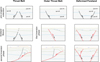 |
Fig. 7 Generalized, synoptic evolutionary model to account for the modes of positive inversion in the Central-Northern Apennines and within the mildly deformed Adria foreland domain, based on the structures and situations illustrated in this contribution. Note that the light blue little arrows indicate stratal onlap relationships of syn-tectonic (syn-inversion) deposits onto deformed substrata. |
5 Concluding remarks
The brief review of positive inversion structures illustrated in this contribution outlines an increasing complexity in fault reactivation vs. truncation patterns proceeding from distal foreland domains towards orogenic interiors. In the Central-Northern Apennines orogenic belt, that extends along the “backbone” of peninsular Italy flanking the less intensely deformed Adria microplate, positive inversion tends to be accommodated and taken up by: i) reverse-reactivation of pre-existing faults in the distal provinces; ii) fault truncation in the intermediate zones; and iii) combinations of fault reactivation, associated or not to truncation components − depending on the geometry of precursor faults − in the more internal parts of the orogen. A synthetic 2D evolutionary model to account for the interaction between compressional and extensional deformations described in this contribution, and for the degrees of reactivation vs. truncation modes of positive inversion in the outer zones of the Central-Northern Apennine during migration of the NE-directed orogenic front towards the Adriatic foreland, is illustrated in Figure 7. The geometry and kinematics of structures produced during sequentially younger deformation stages of Figure 7 might tentatively represent a key to interpret the transition from the outer parts of collision orogens towards their mildly deformed foreland domains of other fold-and-thrust belts that have experienced the effects of positive inversion. Of course, each orogenic belt retains its local peculiarities; therefore, a generalization of the model derived from the Apennines and its use to account for the evolution of other belts must only be taken as a gross, first-order indication. However, a comparison between the structures described in this contribution and analogue structures resulting from positive inversion in other, adjacent or distant orogenic belts in the circum-Mediterranean realm, and elsewhere, could represent a useful test to try to unravel their complex geometry and kinematic history. Yet, the evolution of structures investigated in this contribution sheds new light in the history of involvement of pre-existing faults within thrust belts, adding complexity to otherwise well-known and well-documented positive inversion styles. In addition to this cautionary statement, further investigation is necessary to highlight additional controlling factors of positive inversion structures, such as mechanical, thermal and/or rheological properties of the deformed rock sequences, as well as the presence or absence of fluid circulation during the incorporation of extensional basins into thrust-dominated orogenic systems.
Acknowledgements
This review paper arises from joint research carried out by the Authors in the central-northern Apennines of Italy for over two decades. Constructive reviews by Alfonsa Milia and by two anonymous Referees, along with the supportive editorial handling for the BSGF by L. Jolivet, J. Soto and C. Gorini, led to significant improvement with respect to the originally submitted version and are here gratefully acknowledged.
References
- Albouy E, Casero P, Eschard R, Rudkiewicz JL, Barrier L. 2003. Structural/stratigraphic modelling of wedge top basins in the Central Apennines. American Association of Petroleum Geology, Search and Discovery Article #90017. Proceedings of the AAPG International Conference, Barcelona, 21–24 September 2003. [Google Scholar]
- Alvarez W. 1990.Pattern of extensional faulting in pelagic carbonates of the Umbria-Marche Apennines of central Italy. Geology 18: 407–410. https://doi.org/10.1130/0091-7613 [Google Scholar]
- Alvarez W, Cocozza T, Wezel FC. 1974. Fragmentation of the Alpine orogenic belt by microplate dispersal. Nature 248: 309–314. [Google Scholar]
- Argnani A, Gamberi F. 1995. Stili strutturali al fronte della catena appenninica nell’Adriatico centro-settentrionale. Studi Geologici Camerti, Nuova Serie, 1: 19–27. [Google Scholar]
- Artoni A. 2013. The Pliocene-Pleistocene stratigraphic and tectonic evolution of the Central sector of the Western Periadriatic Basin of Italy. Mar Pet Geol 42: 82–106. [Google Scholar]
- Baldanza A, Colacicchi R, Parisi G. 1982. Controllo tettonico sulla deposizione dei livelli detritici nella Scaglia Cretaceo-Paleocenica (Umbria Orientale). Rend Soc Geol Ital 5: 11–14. [Google Scholar]
- Bally A. 1984. Tectogenese et sismique reflexion. Bull Soc Géol Fr 29: 279–285. [Google Scholar]
- Bally AW, Burbi L, Cooper C, Ghelardoni R. 1986. Balanced sections and seismic reflection profiles across the Central Apennines. Mem Soc Geol Ital 35: 257–310. [Google Scholar]
- Barchi M, Tavarnelli E. 2022. Thin vs. thick-skinned tectonics in the Umbria-Marche fold-and-thrust belt: Contrast or coexistence? In: Koeberl C, Claeys P, Montanari A, eds. From the Guajira Desert to the Apennines, and from Mediterranean Microplates to the Mexican Killer Asteroid: Honoring the Career of Walter Alvarez. Geol Soc Am Spec Paper 557: 1–14. https://doi.org/10.1130/2022.2557(05). [Google Scholar]
- Barchi MR. 2010. The Neogene-Quaternary evolution of the northern Apennines: crustal structure, style of deformation and seismicity. In Beltrando M, Peccerillo A, Mattei M, Conticelli S, Doglioni C, eds. The Geology of Italy: Tectonics and Life along Plate Margins. Journal of the Virtual Explorer 36:11. https://doi.org/10.3809/jvirtex.2010.00220 [Google Scholar]
- Barchi MR, Minelli G, Pialli G. 1998. The CROP 03 profile: a synthesis of results on deep structures of the Northern Apennines. Mem Soc Geol Ital 52: 383–400. [Google Scholar]
- Bertotti G, Casolari E, Picotti V. 1999. The Gargano Promontory, a Neogene fold-and-thrust belt within the Adriatic plate. Terra Nova 11: 168–173. [Google Scholar]
- Bigi S, Calamita F, Centamore E. 1995. Caratteristiche geologico-strutturali dell’area abruzzese ad oriente del Gran Sasso. Studi Geol Camerti 1995/2: 67–76. [Google Scholar]
- Billi A, Tiberti MM. 2009. Possible causes of arc development in the Apennines, central Italy. Geol Soc Am Bull 121: 1409–1420. [Google Scholar]
- Bosellini A. 2004. The western passive margin of adria and its carbonate platforms. Ital J Geosci, Spec. 1: 79–92. [Google Scholar]
- Buchanan JG, Buchanan PG, eds. 1995. Basin inversion. Geoogical Soc London Spec Publ 88. https://doi.,org/10.1144/GSL.SP.1995.088.01.30 [Google Scholar]
- Butler RWH. 1989. The influence of pre-existing basin structure on thrust system evolution in the Western Alps. In Cooper MA, Williams GD, eds. Inversion Tectonics, Geological Society of London Special Publications, 44: 105–122. [Google Scholar]
- Butler RWH, Mazzoli S. 2006. Styles of continental contraction: a review. In Mazzoli S, Butler RWH eds. Styles of Continental Contraction. Geological Society of America, Special Papers 414: 1–10. [Google Scholar]
- Butler RWH, Tavarnelli E, Grasso M. 2006. Structural inheritance in mountain belts: an Alpine-Apennine perspective. J Struct Geol 1893-1908. https://doi.or/10.1016/j.jsg.2006.09.006 [Google Scholar]
- Calabrò RA, Corrado S, Di Bucci D, Robustini P, Tornaghi M. 2003. Thick-skinned vs. thick-skinned tectonics in the Matese Massif, Central-Southern Apennines (Italy). Tectonophysics 377 (Issues 3-4): 269–297. [Google Scholar]
- Calamita F, Deiana G. 1988. The arcuate shape of the Umbria-Marche-Sabina Apennines (Central Italy). Tectonophysics 146: 139–147. [Google Scholar]
- Calamita F, Deiana G, Invernizzi C, Mastrovincenzo S. 1987. Analisi strutturale della linea «Ancona-Anzio Auctorum» tra Cittareale e Micigliano (Rieti). Boll Soc Geol Ital 106: 365–375. [Google Scholar]
- Calamita F. 1990. Thrusts and fold-related structures in the Umbria-Marche Apennines (Central Italy). Annales Tectonicae IV: 83–117. [Google Scholar]
- Calamita F, Pizzi A, Ridolfi M, Rusciadelli G, Scisciani V. 1998. Il buttressing delle faglie sinsedimentarie pre-thrusting sulla strutturazione neoge- nica della catena appenninica: l’esempio della M.gna dei Fiori (Appennino Centrale esterno. Boll Soc Geol Ital 117: 725–745. [Google Scholar]
- Calamita F, Paltrinieri W, Peolorosso M, Scisciani V, Tavarnelli E. 2003. Inherited mesozoic architecture of the Adria continental palaeomargin in the neogene Central Apennines orogenic system, Italy. Boll Soc Geol Ital 122: 307–318. [Google Scholar]
- Calamita F, Satolli S, Scisciani V, Esestime P, Pace P. 2011. Contrasting styles of fault reactivation in curved orogenic belts: Examples from the Central Apennines (Italy). Geol Soc Am Bull 123: 5–6., 1097–1111. https://doi.org/10.1130/ B30276.1 [Google Scholar]
- Calamita F, Satolli S, Turtù A. 2012. Analysis of thrust shear zones in curve-shaped belts: deformation mode and timing of the Olevano-Antrodoco-Sibillini thrust (Central/Northern Apennines of Italy). J Struct Geol 44: 179–187. https://doi.org/ 10.1016/j.jsg.2012.07.007. [Google Scholar]
- Calamita F, Di Domenica A, Pace P. 2018. Macro- and meso-scale structural criteria for identifying pre-thrusting normal faults within foreland foldand- thrust belts: Insights from the Central-Northern Apennines (Italy). Terra Nova 30: 50–62. https://doi.org/10.1111/ter.12307. [Google Scholar]
- Calamita F, Pace P, Scisciani V, Properzi F, Francioni M. 2021. Dinaric up-thrusts in the Pliocene evolution of the Central Apennines thrust belt of Italy: the Montagna dei Fiori structure. Geol Mag 158: 2063–2078. https://doi.org/10.1017/S0016756821000613. [Google Scholar]
- Casero P. 2004. Structural setting of petroleum exploration plays in Italy. In Crescenti U, D’Offizi S, Merlini S, Sacchi R, eds. “Geology of Italy”. Bollettino della Società Geologica Italiana, Special Volume for the Geological International Congress, Florence 2004, 189–199 [Google Scholar]
- Casero P, Bigi S. 2013. Structural setting of the Adriatic basin and the main related petroleum exploration plays. Mar Pet Geol 42: 135–147. https://doi.org/10.1016/j.marpetgeo.2012.07.006 [Google Scholar]
- Casero P, Roure F, Vially R. 1991. Tectonic framework and petroleum potential of the Southern Apennines. In: Spencer AM, ed. Generation, accumulation and production of Europe’s hydrocarbons. European Association of Petroleum Geosciences, Special Publications 1, 381–387. [Google Scholar]
- Cassinis G, Cortesogno L, Gaggero L, Perotti C, Buzzi L. 2008. Permian to Triassic geodynamic and magmatic evolution of the Brescian Prealps (Eastern Lombardy,Italy). Boll Soc Geol Ital 127, 3: 501–518. [Google Scholar]
- Castellarin A, Colacicchi R, Praturlon A, Cantelli C. 1982. The Jurassic-lower Pliocene history of the Ancona-Anzio line (Central Italy). Mem Soc Geol Ital 24: 325–336. [Google Scholar]
- Cello G, Mazzoli S. 1999. Apennine tectonics in southern Italy: a review. J Geodyn 27: 191–211. [Google Scholar]
- Centamore E, Chiocchini M, Deiana G, Micarelli A, Pieruccini U. 1969. Considerazioni preliminari su alcune serie mesozoiche dell’Appennino Umbro-Marchigiano. Mem Soc Geol Ital 8,3: 237–263. [Google Scholar]
- Centamore E, Chiocchini M, Deiana G, Micarelli A, Pieruccini U. 1971. Contributo alla conoscenza del Giurassico dell’Appennino Umbro-Marchigiano. Studi Geol Camerti 1: 7–89. [Google Scholar]
- Centamore E, Rossi D, Tavarnelli E. 2009. Geometry and kinematics of Triassic-to-Recent structures in the Northern-Central Apennines: a review and an original working hypothesis. Ital J Geosci 128: 419–432. [Google Scholar]
- Colacicchi R, Passeri L, Pialli G. 1970. Nuovi dati sul Giurese Umbro-Marchigiano ed ipotesi per un suo inquadramento regionale. Mem Soc Geol Ital 9: 839–874. [Google Scholar]
- Connolly J, Anderson M, Mottram C, Price GD, Parrish R, Sanderson DJ. 2024. Using U-Pb carbonate dating to constrain the timing of extension and fault reactivation within the Bristol Channel Basin, SW England. J Geol Soc London 181: jgs 2024–021 [Google Scholar]
- Cooper MA, Williams GD, eds. 1989. Inversion tectonics. Geol Soc London Special Publ 44. [Google Scholar]
- Cooper MA, Warren MJ. 2010, The geometric characteristics, genesis and petroleum significance of inversion structures. In Law RD, Butler RWH, Holdsworth RE, Krabbendam M, Strachan RA, eds. Continental Tectonics and Mountain Building: The Legacy of Peach and Horne Geological Society of London, Special Publications, 335: 827–846. [Google Scholar]
- Corfield SM, Gawthorpe RL, Gage M, Fraser AJ, Besley A. 1996. Inversion tectonics of the Variscan foreland of the British Isles.J Geol Soc London 153: 17–32. https://doi.org/10.1144/gsjgs.153.1.0017 [Google Scholar]
- Coward MP. 1994. Inversion tectonics. In: Hancock PL, ed. Continental Deformation. Pergamon Press, pp. 289–304. [Google Scholar]
- Coward MP, DeDonatis M, Mazzoli W, Paltrinieri W, Wezel FC. 1999. Frontal part of the northern Apennines fold and thrust belt in the Romagna-Marche area (Italy): shallow and deep structural styles. Tectonics 18: 559–574. https://doi.org/10.1029/1999TC900003. [Google Scholar]
- De Graciansky PC, Dardeau G, Lemoine M, Tricart P. 1989. The inverted margin of the French Alps and foreland basin inversion. In Cooper MA, Williams GD, eds. Inversion Tectonics.Geological Society of London, Special Publications, 44: 87–104. [Google Scholar]
- De Paola N, Holdsworth RE, McCaffrey JW, Barchi MR. 2005. Partitioned transtension: an alternative to basin inversion models. J Struct Geol 27, 4: 607–625. https://doi.org/10.1016/jsg.2005.01.006 [Google Scholar]
- De Paola N, Mirabella F, Barchi MR, Burchielli F., 2006. Early orogenic normal faults and their reactivation during thrust belt evolution: The Gubbio Fault case study, Umbria-Marche Apennines (Italy). J Struct Geol 28: 1948–1957. [Google Scholar]
- Decandia FA. 1982. Geologia dei Monti di Spoleto (Prov. di Perugia). Bollettino della Società Geologica Italiana, 101: 291–315. [Google Scholar]
- Dewey JF, Bird JM. 1970. Mountain belts and the new global tectonics. J Geophys Res 75: 2625–2647. [CrossRef] [Google Scholar]
- Di Domenica A, Turtù A, Satolli S, Calamita F. 2012. Relationships between thrusts and normal faults in curved belts: new insight in the inversion tectonics of the Central-Northern Apennines. J Struct Geol 42: 104–117. https://doi.org/10.1016/j.jsg.2012.06.008. [Google Scholar]
- Di Domenica A, Petricca P, Trippetta F, Carminati E Calamita F. 2014. Investigating fault reactivation during multiple tectonic inversions through mechanical and numerical modeling: an application to the Central-Northern Apennines of Italy. J Struct Geol 67: 167–185. https://doi.org/10.1016/j. jsg.2014.07.018. [Google Scholar]
- Di Francesco L, Fabbi S, Santantonio M, Bigi S, Poblet J. 2010. Contribution of different kinematic models and a complex Jurassic stratigraphy in the construction of a forward model for the Montagna dei Fiori fault related fold (Central Apennines, Italy). Geol J 45: 489–505. [Google Scholar]
- Doglioni C, Siorpaes C. 1990. Polyphase deformation in the Col Bechei area (Dolomites − Northern Italy). Eclogae Geol Helv 83/3: 701–710. [Google Scholar]
- Ghisetti F, Vezzani L. 2000. Detachments and normal faulting in the Marche fold-and-thrust belt (central Apennines,Italy): inferences on fluid migration paths. J Geodyn 29: 345–69. [Google Scholar]
- Ghisetti F, Barchi MR, Bally AW, Moretti I, Vezzani L. 1993. Conflicting balanced structural sections across the Central Apennines (Italy): problems and implications. In: Spencer AM, ed. Generation, accumulation and production of Europe’s hydrocarbons III. European Association of Petroleum Geology, Special Publicatiions, 3, Springer, 9–18. https://doi.org/10.1007/978-3-642-77859-918 [Google Scholar]
- Giannini E. 1960. Osservazioni geologiche sulla Montagna dei Fiori (Ascoli Piceno-Teramo). Boll Soc Geol Ital 79: 183–206. [Google Scholar]
- Giannini E, Lazzarotto A, Zampi M. 1970. Studio stratigrafico e micropaleontologico del Mesozoico della Montagna dei Fiori (Ascoli Piceno- Teramo). Meorie Soc Geol Ital 9: 29–53. [Google Scholar]
- Gidon M. 1981. Les déformations de la couverture des Alpes occidentales externes dans la région de Grenoble: leurs rapports avec celles du socle. CR Acad Sci, Paris, 292: 1057–1060. [Google Scholar]
- Gillcrist R, Coward MP, Mugnier JL. 1987. Structural inversion examples from the Alpine foreland and the French Alps. Geodin Acta 1: 5–34. https://doi.org/10.1080/09853111.1987.11105122 [Google Scholar]
- Glennie K, Boegner PLE. 1981. Sole pit inversion tectonics. In: Illing LV, Hobson GD, eds. Petroleum Geology of the Continental Shelf of Northwest Europe. Institute for Petroleum, London, 110–120. [Google Scholar]
- Harding TP. 1985. Seismic characteristics and identification of negative flower structures, positive flower structures, and positive structural inversion. Am Assoc Pet Geol Bull 69: 582–600. [Google Scholar]
- Hill KC, Hayward AB. 1988. Structural constraints on the Tertiary plate tectonic evolution of Italy. Mar Pet Geol 5: 2–16. https://doi.org/10.1016/0264-8172(88)90036-0. [Google Scholar]
- Koopman A. 1983. Detachment tectonics in the central Apennines, Italy. Geologica Ultraiectina 30: 1–155. [Google Scholar]
- Invernizzi C, Ridolfi M. 1992. Analisi geologico-strutturale delle formazioni oligo-mioceniche dell’area della Montagna dei Fiori (Marche meridionali). Studi Geol Camerti 12: 79–91. [Google Scholar]
- Lavecchia G, Minelli G, Pialli GP. 1988. The Umbria-Marche arcuate fold belt (Italy). Tectonophysics 146: 125–137. [Google Scholar]
- Lemoine M, Bas T, Arnaud-Vanneau A, Amaud H, Dumont T, Gidon M, et al. 1986. The continental margin of the Mesozoic Tethys in the Western Alps. Mar Pet Geol 3: 179–199. [CrossRef] [Google Scholar]
- Letouzey J. 1990. Fault reactivation and fold-thrust belt. In: Letouzey J, ed. Petroleum and Tectonics in Mobile Belts. Technip, Paris 101–128. [Google Scholar]
- Livani M, Scrocca D, Arecco P, Doglioni C. 2018. Structural and stratigraphic control on salient and recess development along a thrust belt front: the Northern Apennines (Po Plain, Italy). J Geophys Res, Solid Earth, 123. https://doi.org/10.1002/2017JB015235 [Google Scholar]
- Mattei M. 1987. Analisi geologico-strutturale della montagna dei fiori (Ascoli Piceno,Italia centrale). Geol Romana 26: 327–47. [Google Scholar]
- Mazzoli S, Corrado S, De Donatis M, Scrocca D, Butler RWH, Di Bucci D, et al. 2000. Time and space variability of “thin-skinned” and “thick-skinned” thrust tectonics in the Apennines (Italy). Rendiconti Lincei 9: 5–39. [Google Scholar]
- Mazzoli S, Deiana G, Galdenzi S, Cello G. 2002. Miocene fault-controlled sedimentation and thrust propagation in the previously faulted external zones of the Umbria-Marche Apennines, Italy. In: Bertotti G, Schulmann K, Cloetingh SAPL, eds. Continental Collision and the Tectono-Sedimentary Evolution of Forelands, EGU, Stephan Mueller Publication Series, 195–209. [Google Scholar]
- Mazzoli S, Pierantoni PP, Borraccini F, Paltrinieri W, Deiana G. 2005. Geometry, segmentation pattern and displacement variations along a major Apennine thrust zone, central Italy. J Struct Geol 27:1940–1953. https://doi.org/10.1016/j.jsg.2005.06.002. [Google Scholar]
- Milia A, Torrente MM. 2015. Rift and supradetachment basins during extension: insights from the Tyrrhenian rift. J Geol Soc London 72: 5–8. https://doi.org/10.1144/jgs 2014-046. [Google Scholar]
- Milia A, Torrente MM, Tesauro M. 2017. From stretching to mantle exhumation in a triangular backarc basin (Vavilov basin, Tyrrhenian Sea, Western Mediterranean). Tectonophysics 710–711:108–126. https://doi.org/10.1016/j.tecto.2016.10.017 [Google Scholar]
- Montanari A, Chan LS, Alvarez W. 1989. Synsedimentary tectonics in the Late Cretaceous-Early Tertiary pelagic basin of the Northern Apennines, Italy. In: Crevello PD, Wilson JL, Sarg JF, Read JF, eds. Controls on Carbonate Platforms and Basin Development. Society for Sedimentary Geology (SEPM), Special Publications 44, 379–399. [Google Scholar]
- Pace P, Calamita F. 2014. Push-up inversion structures vs. fault-bend reactivation anticlines along oblique thrust ramps: examples from the Apennines fold-and-thrust belt (Italy). J Geol Soc London 171: 227–238. [Google Scholar]
- Pace P, Scisciani V, Calamita F, Butler RWH, Iacopini D, Esestime P, et al. 2015. Inversion structures in a foreland domain: seismic examples from the Italian Adriatic Sea. Interpretation 3: SA A161–76. [Google Scholar]
- Pace P, Pasqui V, Tavarnelli E, Calamita F. 2017. Foreland-directed gravitational collapse along curved thrust fronts: insights from a minor thrustrelated shear zone in the Umbria-Marche belt, central-northern Italy. Geoogical Mag 154: 381–392. [Google Scholar]
- Pace P, Calamita F, Tavarnelli E. 2022a. Along-strike variation of fault-related inversion folds within curved thrust systems: the case of the Central-Northern Apennines of Italy. Mar Pet Geol 142: 105731. https://doi.org/10.1016/j.marpetgeo.2022.105731. [Google Scholar]
- Pace P, Calamita F, Tavarnelli E. 2022b. Shear zone fabrics and their significance in curved, inverted basin-derived thrust systems. J Struct Geol 161: 104663. https://doi.org/10.1016/j.jsg.2022.104663. [Google Scholar]
- Paltrinieri W, Zanchini G, Martini N, Roccia L. 1982. Evoluzione del Bacino torbiditico Marchigiano Abruzzese a partire dal Messiniano, in base a Lineazioni profonde. Memorie Soc Geol Ital 24: 233–42. [Google Scholar]
- Patacca E, Scandone P. 2004. The Plio-Pleistocene thrust belt-foredeep system in the southern Apennines and Sicily (Italy). In Crescenti U, D’Offizi S, Merlini S, Sacchi R, eds. Geology of Italy. Bollettino della Società Geologica Italiana, Special Volume for the Geological International Congress, Florence, 2004, 93–129 [Google Scholar]
- Patacca E, Scandone P, Di Luzio E, Cavinato GP, Parotto M. 2008. Structural architecture of the central Apennines: Interpretation of the CROP 11 seismic profile from the Adriatic coast to the orographic divide. Tectonics 27: TC3006. https://doi.org/10.1029/2005TC001917 [Google Scholar]
- Pierantoni PP, Deiana G, Romano A, Paltrinieri W, Borraccini F, Mazzoli S. 2005. Geometrie strutturali lungo la thrust zone del fronte montuoso umbro-marchigiano-sabino. Boll Soc Geol Ital 124: 395–411. [Google Scholar]
- Pierantoni PP, Deiana G, Galdenzi S. 2013. Stratigraphic and structural features of the Sibillini mountains (Umbria-Marche Apennines, Italy). Ital J Geosci 132: 497–520. https://doi.org/10.3301/IJG 2013.08 [Google Scholar]
- Pizzi A, Galadini F. 2009. Pre-existing cross-structures and active fault segmentation in the northern-central Apennines (Italy). Tectonophysics 476: 304–319. https://doi. org/10.1016/j.tecto.2009.03.018. [Google Scholar]
- Pizzi A, Di Domenica A, Gallovǐc F, Luzi L, Puglia R. 2017. Fault segmentation as constraint to the occurrence of the main shocks of the 2016 Central Italy seismic sequence. Tectonics 36: 2370–2387. https://doi.org/10.1002/2017 TC004652. [Google Scholar]
- Platt NH, Cartwright JA. 1998. Structure of the East Shetland Platform, northern North sea. Pet Geosci 4: 353–362. https://doi.org/10.1144/petgeo.4.4.353 [Google Scholar]
- Porkoláb K, Willingshofer E, Sokoutis D, Creton I, Kostopoulos D, Wijbrans J. 2019. Cretaceous-Paleogene tectonics of the Pelagonian zone: inferences from Skopelos island (Greece).Tectonics 38: 1946–73. [Google Scholar]
- Porreca M, Fabbrizzi A, Azzaro S, Pucci S, Del Rio L, Pierantoni PP, et al. 2020, 3D geological reconstruction of the M. Vettore seismogenic fault system (Central Apennines, Italy): cross-cutting relationship with the M. Sibillini thrust. J Struct Geol 131: 103938. https://doi.org/10.1016/j.jsg.2019.103938. [Google Scholar]
- Roure F, Choukroune P, Berastegui X, Munoz JA, Villien A, Matheron P, et al. 1989. Ecors deep seismic data and balanced cross-sections: Geometric constraints on the evolution of the Pyrenees. Tectonics 8, 1: 41–50. https://doi.org/10.1029/TC008i001p00041. [Google Scholar]
- Roure F, Howell DG, Guellec S, Casero P. 1990. Shallow structures induced by deep-seated thrusting. In: Letouzey J, ed. Petroleum Tectonics in Mobile Belts. Technip, Paris, 15–30. [Google Scholar]
- Roure F, Nazaj S, Mushka K, Fili I, Cadet J-P., Bonneau M. 2004. Kinematic evolution and Petroleum Systems − An Appraisal of the Outer Albanides. In: McClay KR, ed. Thrust Tectonics and hydrocarbon systems. American Association of Petroleum Geologists, Memoirs, 82: 474–493. [Google Scholar]
- Roure F, Casero P, Addoum B. 2012. Alpine inversion of the North African margin and delamination of its continental lithosphere. Tectonics 31: TC3006. https://doi.org/10.1029/2011TC002989 [Google Scholar]
- Salvini F, Vittori E. 1982. Analisi strutturale della linea Olevano-Antrodoco-Posta (Ancona-Anzio Auctt.): metodologia di studio delle deformazioni fragili e presentazione del tratto meridionale. Memorie Soc Geol Ital 24: 337–355. [Google Scholar]
- Santantonio M. 1993. Facies association and evolution of pelagic carbonate platform ⁄ basin systems: examples from the Italian Jurassic. Sedimentology 40: 1039–1067. https://doi.org/10.1111/j.1365-3091.1993.tb01379.x. [Google Scholar]
- Satolli S, Pace P, Viandante MG, Calamita F. 2014. Lateral variations in tectonic style across cross-strike discontinuities: an example from the Central Apennines belt (Italy). Int J Earth Sci 103: 2301–2313. https://doi.org/10.1007/s00531-014-1052-3. [Google Scholar]
- Schmid SM, Bernoulli D, Fügenschuh B, Matenco L, Schuster R, Schefer S, et al. 2008. The Alpine-Carpathian-Dinaridic orogenic system: correlation and evolution of tectonic units. Swiss J Geosci 101: 139–183. [CrossRef] [Google Scholar]
- Scisciani V. 2009. Styles of positive inversion tectonics in the central Apennines and in the Adriatic foreland: implications for the evolution of the Apennine chain (Italy). J Struct Geol 31: 1276–1294. https://doi.org/10.1016/j.jsg.2009.02.004. [Google Scholar]
- Scisciani V, Montefalcone R. 2006. Coexistence of thin- and thick-skinned tectonics: an example from the Central Apennines, Italy. In: Mazzoli S, Butler RWH, eds. Styles of Continental Contraction. Geological Society of America, Special Papers 414, 33–54. [Google Scholar]
- Scisciani V, Calamita F, Tavarnelli E, Rusciadelli G, Ori GG, Paltrinieri W. 2001. Foreland-dipping normal faults in the inner edges of syn-orogenic basins: a case from the Central Apennines, Italy. Tectonophysics 330: 211–224. [Google Scholar]
- Scisciani V, Agostini S, Calamita F, Pace P, Cilli A, Giori I, et al. 2014. Positive inversion tectonics in foreland fold-and-thrust belts: a reappraisal of the Umbria-Marche Northern Apennines (Central Italy) by integrating geological and geophysical data. Tectonophysics 637: 218–237. [Google Scholar]
- Scisciani V, Patruno S, Tavarnelli E, Calamita F, Pace P, Iacopini D. 2019. Multi-phase reactivations and inversions of Paleozoic-Mesozoic extensional basins during the Wilson cycle: case studies from the North Sea (UK) and the Northern Apennines (Italy) In Wilson RW, Houseman GA, McCaffrey KJW, Dorè AG, Buiter SJH, eds. Geological Society of London, Special Publications, 470, 205–243. [Google Scholar]
- Scrocca D, Carminati E, Doglioni C. 2005. Deep structure of the Southern Apennines, Italy: thin-skinned or thick-skinned? Tectonics 24: TC3005. https://doi.org/10.1029/2004TC001634. [Google Scholar]
- Shiner P, Beccacini A, Mazzoli S. 2004. Thin-skinned versus thick-skinned structural models for Apulian carbonate reservoirs: Constraints from the Val d’Agri Fields, S. Apennines, Italy. Mar Pet Geol 21: 805–827. [Google Scholar]
- Soto JI, Tranos MD, Bega Z, Dooley TP, Hernandez P, Hudec R, et al. 2024, Contrasting styles of salt-tectonic processesin the Ionian Zone (Greece and Albania): Integrating surface geology, subsurface data, and experimental models. Tectonics 43: e2023 TC008104. https://doi.org/10.1029/2023TC008104 [Google Scholar]
- Speranza F, Chiappini M. 2002. Thick-skinned tectonics in the external Apennines, Italy: New evidence from magnetic anomaly analysis. J Geophys Res 107: B11, 2290, https://doi.org/10.1029/2000 JB000027. [Google Scholar]
- Storti F, Balsamo F, Mozafari M, Koopman A, Swennen R, Taberner C. 2018. Syn-contractional overprinting between extension and shortening along the Montagna dei Fiori fault during Plio-Pleistocene antiformal stacking at the central Apennines thrust wedge toe. Tectonics 37: 3690–3720. [Google Scholar]
- Tari G, Arbouille D, Schléder Z, Tòth T. 2020. Inversion tectonics: a brief petroleum industry perspective. Solid Earth 11: 1865–1889. [Google Scholar]
- Tari G, Connors C, Flinch J, Granath J, Pace P, Sobornov K, et al. 2023. Negative structural inversion: an overview. Mar Pet Geol 152: 106223. https://doi.org/10.1016/j.marpetgeo.2023.106223 [Google Scholar]
- Tavani S, Storti F, Lacombe O, Corradetti A, Munoz JA, Mazzoli S. 2015. A review of deformation pattern templates in foreland basin systems and fold-and-thrust belts: Implications for the state of stress in the frontal rtegions of thrust wedges. Earth-Sci Rev 141: 82–104. [CrossRef] [Google Scholar]
- Tavarnelli E. 1996. The effects of pre-existing normal faults on thrust ramp development: an example from the northern Apennines, Italy. Int J Earth Sci 85: 363–371. [Google Scholar]
- Tavarnelli E. 1999. Normal faults in thrust sheets: pre-orogenic extension, postorogenic extension, or both? J Struct Geol 21: 1011–1018. [Google Scholar]
- Tavarnelli E, Butler RWH, Decandia FA, Calamita F, Grasso M, Alvarez W, et al. 2004. Implications of fault reactivation and structural inheritance in the Cenozoic tectonic evolution of Italy. Ital J Geosci Special Volume for the IGC 32 Florence-2004, 209–222. [Google Scholar]
- Tavarnelli E, Scisciani V, Patruno S, Calamita F, Pace P, Iacopini D. 2019. The role of structural inheritance in the evolution of fold-and-thrust belts: insights from the Umbria-Marche Apennines, Italy. In: Koeberl C, Bice DM, eds. 250 Million Years of Earth History in Central Italy: Celebrating 25 Years of the Geological Observatory of Coldigioco. Geological Society of America, Special Papers, 542, 191–212. [Google Scholar]
- Tozer RSJ, Butler RWH, Corrado S. 2002. Comparing thin- and thickskinned thrust tectonic models of the Central Apennines, Italy. In Bertotti G, Schulmann K, Cloetingh SAPL, eds. Continental Collision and the Tectono-Sedimentary Evolution of Forelands. E. G. U., Stephan Mueller Publ. Series, 181–194. [Google Scholar]
- Tozer RSJ, Butler RWH, Chiappini M, Corrado S, Mazzoli S, Speranza F. 2006. Testing thrust tectonic models at mountain fronts: where has the displacement gone? J Geol Soc London 163: 1–14. [Google Scholar]
- Van Unen M, Matenco L, Nader FH, Darnault R, Mandic O, Demir V. 2019. Kinematics of foreland-vergent crustal accretion: Inferences from the Dinarides evolution. Tectonics 38: 49–76. https://doi.org/10.1029/2018TC005066 [Google Scholar]
- Williams GD, Powell CM, Cooper MA. 1989. Geometry and kinematics of inversion tectonics. In Cooper MA, Williams GD, eds. Inversion tectonics. Geological Society of London, Special Publications 44, 3–15. [Google Scholar]
- Zelilidis A, Bourli N, Zoumpouli E, Maravelis AG. 2024. Tectonic inversion and deformation differences in the transition from Ionian Basin to Apulian Platform: the example from Ionian Islands, Greece. Geosciences 14: 203. https://doi.org/10.3390/geosciences14080203 [Google Scholar]
- Ziegler PA. 1987. Late Cretaceous and Cenozoic intraplate compressional deformations in the Alpine foreland: A geodynamic model. Tectonophysics 137: 389–420. https://doi.org/10.1016/0040-1951(87)90330-1. [CrossRef] [Google Scholar]
Cite this article as: Tavarnelli E, Calamita F, Pace P, Scisciani V. 2026. Structural inheritance within the outer zones of arcuate collisional orogens: A case from the Central-Northern Apennine orogenic system, BSGF - Earth Sciences Bulletin 197: 9. https://doi.org/10.1051/bsgf/2026001
All Figures
|
Fig. 1 A comprehensive review of 2D relationships between hinterland- (a) and foreland- dipping (b) precursor normal faults with subsequent thrusts and related folds (c-h). Hinterland-dipping normal faults may be reverse-reactivated (c), truncated (g), or reverse-reactivated to depth and truncated at higher structural levels (h) by upward-propagating thrusts. Foreland-dipping normal faults are generally truncated and passively carried piggy-back in the hangingwall blocks of upward-propagating thrusts (e, f), or may act as loci for thrust ramp nucleation (d). |
| In the text | |
|
Fig. 2 (a) Simplified structural-geological and related composite geological cross-section (b) of the outer Neogene-Quaternary Central-Northern Apennine fold-and-thrust belt and the doformed sector of the Adriatic foreland (modified after Calamita et al. 2021). Please note that the cross-section (b) does not balance: the impossibility to obtain a restored template, essential requirement for balanced cross-sections, is due to the lack of data in the deep parts of the A1-A2 tract (area indicated as “no data”), that prevents to locate footwall cutoff points for the Carbonate succession unit. |
| In the text | |
|
Fig. 3 (a) Seismic section from the Mid-Adriatic Ridge (location in Fig. 1) showing a polyphase inversion structure composed of several Dinaric up-thrusts (DUT) and related folds having an Upper Cretaceous-Oligocene (growth coeval with the onset of the Dinaric foreland contractional deformation and a later reactivation during the Pliocene-Quaternary Apennine phase. (b and c) Close-ups of the seismics with the cosine of phase attribute showing the two phases of growth and inversion (modified after Pace et al., 2015 and Calamita et al., 2021). |
| In the text | |
|
Fig. 4 (a) Geological map of the Montagna dei Fiori structure (modified from Mattei, 1987; Calamita et al., 2011). (b) Panoramic view of the Montagna dei Fiori fault along the forelimb/hinge zone of the anticline, showing the attitude of the footwall strata characterized by 30−40° dip towards the NE. (c) Geological cross-section (trace B-B’ in Fig. 4a). (d) Speculative template showing the interpretation of the Montagna dei Fiori Fault as a syn-orogenic, pre-thrusting normal fault (Calamita et al., 1998; Scisciani et al., 2001). (e) Speculative template showing the interpretation of the Montagna dei Fiori Fault as a NE-directed, high-angle upthrust (DUT) developed during the latest Cretaceous–Middle Miocene time interval (Calamita et al., 2021). Note that the cross-section (c) does not balance, due to the paucity of data to constrain its deeper parts, which prevents its quantitative restoration; however, it is presented here with the only purpose of illustrating the alternative, qualitative interpretations given for the same structure, the Montagna dei Fiori Fault, as a pre-thrusting normal fault (d) or as a West-directed upthust (e). One slightly different, third interpretation for the Montagna dei Fiori Fault, that is yet geometrically and kinematically consistent with the hypothesis of a pre-thrusting normal fault illustrated in Figure 4d, is that this tructure could represent the relicts of a supradetachment fault (terminology after Milia & Torrente, 2015), inherited during the episodes of extension that have accompanied the opening of the Tyrrhenian Sea and preceeded the upward-propagation of the Montagna dei Fiori Thrust (see the text for explanation). |
| In the text | |
|
Fig. 5 Schematic 3D block diagrams illustrating the main structural controls of extensional fault arrays on thrust ramp propagation, resulting in the development of frontal and of oblique-lateral ramps depending on the orientation of precursor faults with respect to the superimposed direction of thrust tectonic transport (inspired to the case of the Olevano-Antrodoco-Mt. Sibillini Thrust. (a) Pre-thrusting template; (b) Thrust distribution as it results from the onset and evolution of orogenic contraction. U-M-S: Umbria-Marche-Sabina Basin; L-A: Latium-Abruzzi Platform; OTR: Olevano Thrust; OAS: Olevano-Antrodoco oblique-lateral thrust ramp; FTR: Mt. Sibillini frontal thrust ramp. |
| In the text | |
|
Fig. 6 Schematic 3D block diagrams illustrating the main structural controls of extensional fault arrays on thrust ramp propagation, resulting in the development of frontal and of oblique-lateral ramps depending on the orientation of precursor faults with respect to the superimposed direction of thrust tectonic transport (inspired to the case of the Olevano-Antrodoco-Mt. Sibillini Thrust. (a) Pre-thrusting template; (b) Thrust distribution as it results from the onset and evolution of orogenic contraction. U-M-S: Umbria-Marche-Sabina Basin; L-A: Latium-Abruzzi Platform; OTR: Olevano Thrust; OAS: Olevano-Antrodoco oblique-lateral thrust ramp; FTR: Mt. Sibillini frontal thrust ramp. |
| In the text | |
|
Fig. 7 Generalized, synoptic evolutionary model to account for the modes of positive inversion in the Central-Northern Apennines and within the mildly deformed Adria foreland domain, based on the structures and situations illustrated in this contribution. Note that the light blue little arrows indicate stratal onlap relationships of syn-tectonic (syn-inversion) deposits onto deformed substrata. |
| In the text | |
Current usage metrics show cumulative count of Article Views (full-text article views including HTML views, PDF and ePub downloads, according to the available data) and Abstracts Views on Vision4Press platform.
Data correspond to usage on the plateform after 2015. The current usage metrics is available 48-96 hours after online publication and is updated daily on week days.
Initial download of the metrics may take a while.